FIA 2026: Anduril pitches Thunder as force multiplier for Boeing’s AH-64 Apache
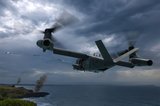
Anduril’s Thunder autonomous tiltrotor aircraft is being pitched as a loyal wingman for the AH-64 Apache. (Photo: Anduril)
Anduril Industries has unveiled Thunder, a group 5 autonomous tiltrotor aircraft billed as a “loyal wingman” for the Apache attack helicopter, with the US defence technology company formally launching the platform at Farnborough International Airshow 2026 on 20 July.
The uncrewed rotorcraft was previewed to journalists ahead of the show by Dr Rich Drake, general manager of Anduril UK, and Shane Arnott, SVP of engineering, who framed Thunder as a response to the growing vulnerability of attack helicopters over the modern battlefield.
Filling the gap for Apache
Apache entered service with the US Army in the late 1980s and with the British Army’s Army Air Corps in 2001, but the threat picture around near-surface flight has changed considerably since then. Man-portable air defence systems, loitering munitions and low-cost air defence capabilities have all increased the risk to crewed attack aviation, according to Drake.
Related Articles
MQ-28A Ghost Bat: Australia’s drone charts the future of loyal wingman UAVs
Hunt begins for drone to team with British Army Apaches
Fuselage of the first US Army MV-75 Cheyenne tiltrotor “is nearing completion”
Apache remains a formidable helicopter, but Drake described it as an “exquisite” platform: expensive to build, slow to replace and limited in number. According to figures from 2025, the UK operates a fleet of 47 Apaches, of which 38 are in service. Drake said the value of trained crews meant that attack helicopters were increasingly held back from the deep fight, at the point when the ability to strike behind enemy lines mattered most.
“The realities of the modern battlefield demand additional combat mass capable of delivering more effects across a wider area, while also increasing the survivability of crewed attack aviation,” Drake said, adding that the British Army and NATO more broadly required a new strike capability able to penetrate adversary air defences.

Arnott set out Thunder’s specifications, describing it as a hybrid-electric tiltrotor with performance benchmarked against the Bell MV-75. Thunder is intended to cruise at speeds in excess of 200kt, considerably faster than Apache, with a range extending to thousands of nautical miles, which Arnott said would allow the aircraft to operate across the distances required in the Pacific or in NATO’s High North.
The aircraft carries a payload broadly comparable to that of the Apache, housed internally to preserve a clean aerodynamic profile at long range. Arnott described a central payload bay accommodating up to five Hellfire missiles, a laser-designator pod and Hydra rockets or Advanced Precision Kill Weapon System munitions, alongside a forward payload bay that can be configured with an upward-firing counter-uncrewed aerial system (CUAS) capability to defend against small group 1 drones.
The operating concept envisages three to six Thunders flying with each Apache, extending forward or around the crewed aircraft to provide what Arnott called a “protective ring of steel” against CUAS threats and man-portable air defence systems, while also acting as an additional magazine of weapons for the formation.
Thunder draws heavily on Anduril’s partnership with Archer Aviation, the US electric vertical take-off and landing (eVTOL) aircraft manufacturer, which the companies formalised in 2025. Arnott said Thunder reused technology from Archer’s Midnight eVTOL aircraft, adapted with a hybrid-electric powertrain to extend range, allowing Anduril to draw down production lines and supply chain investment that Archer has already built up in the commercial eVTOL sector.
“This gives us the ability to get a price point that just isn’t achievable any other way,” Arnott said, adding that the intent was to bring the unit cost of Thunder down to a small fraction of that of Apache, enabling the aircraft to be fielded at scale.
Arnott added that Thunder is designed to break down into a standard 40ft shipping container. The company said it is initially sizing production facilities for around 50 aircraft annually, with scope for further expansion if required.
Development of Thunder has been underway for more than two years, according to Arnott. Anduril said it was not linking the Thunder launch to Project NYX, a separate and active UK competition for an uncrewed rotary-wing capability, despite parallels between the two.
Market and next steps
Responding to a question from Shephard on Thunder’s survivability, Arnott pointed to the aircraft’s optimum speed tilt rotor (OSTR) technology, which he said gives Thunder an acoustic signature that is a fraction of the Apache’s, reducing its vulnerability to man-portable air defence systems. Anduril has also invested heavily in terrain-sensing perception technology intended to let Thunder fly low and fast in a manner comparable to a human pilot.
Arnott linked the design philosophy directly to lessons from Ukraine, where both Russian and Ukrainian forces have adapted rotorcraft tactics to fly low and fast in response to pervasive air defence and loitering munition threats.
Anduril said it could not disclose the identity of current customers working with it on Thunder, though Arnott confirmed government customers were already involved. He said the intended customer base extended to any operator of reconnaissance or attack helicopters. Asked by Shephard whether Apache operators represented the primary target market, Arnott replied: “Anyone who operates Apaches, anyone who operates attack helicopters.”
Anduril intends to begin flying Thunder in 2027, with the version on display at Farnborough described as a full-size engineering baseline replica.
Arnott compared the approach to the collaborative combat aircraft concept being pursued for crewed fast jets, applied instead to the near-surface rotary-wing fight. Describing the concept in more detail at Farnborough, Arnott said a package of Thunders could fly ahead of a crewed formation “soaking up the first salvo, hunting the missile batteries, finishing them before any human comes across the line into their killer zone”, extending the reach and survivability of attack helicopter crews.
Shephard’s Farnborough International Airshow coverage is sponsored by MBDA

Related Equipment in Defence Insight
More from Farnborough International Airshow 2026 | View all news
-
FIA 2026: Gripen marks operational milestone as Ukraine deal moves forward
At the end of June, Ukraine and Sweden signed a landmark deal which calls for a first batch of used Gripen C/Ds to be delivered from 2027, followed by the more advanced Gripen E.
-
Artificial intelligence: the hope, the hype and the real-world reality
Artificial intelligence has supported C2 systems and decision-making for more than two decades. It has gradually built up a head of steam in the 2020s, but what is it achieving today and what role could it play in the future?
-
Canadian observer status reinforces GCAP’s strength in emerging ‘middle power’ bloc
The significant setback seen by FCAS earlier this year has secured GCAP’s position as Europe’s future sixth-generation fighter, while Canada’s potential observer status could push the programme into the next stage.