Eurosatory 2026: How are air forces integrating autonomous wingmen into existing fleets?
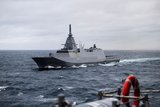
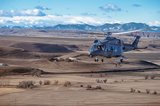
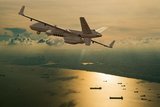
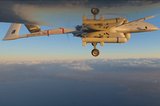
Multi-domain teaming is one of the more significant near-term operational opportunities for V-BAT. (Photo: Shield AI)
The combination of cost pressure, survivability concerns and operational flexibility is forcing militaries to re-evaluate decades-long reliance on high-end crewed platforms.
The economics of modern airpower have long disadvantaged smaller militaries. Fifth-generation fighters carry price tags that most allied nations cannot sustain, and even those that can afford initial acquisition face compounding costs in sustainment, readiness and dependency on the country of origin for software updates.
This reassessment is not limited to one vendor or platform category. Air forces globally are exploring mixtures of crewed aircraft, attritable systems and fully autonomous platforms as part of a push towards distributed force design.
Related Articles
Shield AI unveils V-Bat block upgrade
Shield AI unveils new autonomous VTOL fighter jet concept
Are counter-drone systems for dismounted troops emerging as the next procurement battle?
Speaking to Shephard ahead of Eurosatory 2026, Shield AI outlined a vision in which its Hivemind artificial intelligence (AI) piloting software, its V-BAT uncrewed aerial system (UAS) and its forthcoming X-BAT vertical take-off and landing (VTOL) combat aircraft together constitute something the traditional acquisition model has rarely delivered: credible air capability at a fraction of legacy cost, operable without fixed basing infrastructure, and scalable across allied force structures of any size.
One of the more structurally significant arguments Shield AI is advancing is about dependency. Traditional combat aircraft, whether fourth or fifth-generation, are bound to fixed or hardened infrastructure: runways, hangars, fuel depots, control towers and air defence coverage. Peer adversaries have invested heavily in the ability to hold exactly that infrastructure at risk.
This vulnerability has become more pronounced in recent conflicts, where precision strike and long-range fires have made large, static airbases increasingly exposed.
X-Bat launches from a mobile trailer that can be repositioned every 15 to 30 minutes after a sortie. It requires no hangar, no pavement, no control tower and no organic air defence. It can launch from a ship deck, a highway or any space large enough to accommodate a 40ft footprint.
At mission level, multiple X-BATs operate as a coordinated team under a single human operator, with Hivemind managing role allocation and communications across the swarm.
“A trailer that moves every 15 to 30 minutes after launch is extraordinarily difficult to target.”— Shield AI spokesperson
Force enablement, not just force multiplication
Shield AI force multiplication implies an existing capability being enhanced. Force enablement implies a capability that was previously absent – and that is the more consequential claim for the company’s target market.
Rather than simply augmenting high-end fleets, autonomous systems are being positioned to fundamentally expand who can field credible airpower.
For smaller air forces, X-BAT’s lifecycle cost – estimated at approximately one-tenth that of a fifth-generation fighter – makes credible autonomous strike and intelligence, surveillance and reconnaissance (ISR) achievable where it was not before. The aircraft does not require a crewed quarterback to operate; Hivemind enables it to execute missions independently in GPS-denied, communications-degraded environments. It can also integrate as an autonomous wingman alongside Typhoon, F-16 and Gripen when that construct is operationally appropriate.

For smaller navies, the proposition is arguably more striking. Three X-BATs fit in the deck space occupied by one legacy fighter. An amphibious assault ship can carry approximately 60.
This aligns with a trend towards increasing deck density and diversifying embarked air wings, particularly as navies seek to maximise capability from existing hulls without the cost of new carrier programmes.
Hivemind is Shield AI’s end-to-end AI pilot stack, designed to enable autonomous mission execution in GPS-denied and communications-denied environments. It currently flies on more than 30 classes of uncrewed systems – including Ukrainian attack drone platforms, the Anduril YFQ-44A and the Boeing MQ-20 Avenger. The company piloted the first fully autonomous combat mission using Hivemind in 2018.
The architecture is deliberately platform-agnostic. Integration of Hivemind onto the HII Romulus USV took less than six weeks. Integration onto Ukrainian one-way attack drone platforms took eight weeks before operational deployment. Mitsubishi Heavy Industries went from initial training to first flight in 60 days.
Partners including Korea Aerospace Industries (KAI), Singapore Technologies Engineering (ST Engineering) and Taiwan’s National Chung-Shan Institute of Science and Technology (NCSIST) are building on Hivemind against their own mission requirements, with the intellectual property remaining sovereign. The Republic of Singapore Air Force demonstrated autonomous search and rescue operations and is advancing towards crewed-uncrewed teaming.
The maritime opportunity extends beyond ship-based V-BAT ISR. Shield AI’s partnership with HII on the Romulus USV integrates Hivemind as a contributing autonomy layer alongside HII’s Odyssey autonomy stack, creating a USV that can serve as a mothership and communications node, launch and recover an uncrewed underwater vehicle (UUV) for subsurface ISR or mine countermeasures, and cue V-BAT for over-the-horizon identification. A live demonstration of Hivemind maritime capability on a Thunder Tiger USV in Taiwan took place earlier this year, with a follow-on exercise planned.
Mission capability flights for X-BAT are planned for 2029, with VTOL demonstrations scheduled for later in 2026 followed by progressive flight envelope expansion, engine integration and Hivemind autonomous mission profiling.
Related Programmes in Defence Insight
Related Equipment in Defence Insight
More from Eurosatory 2026
-
Eurosatory 2026: Savox launches MissionCore battlefield integration platform
Savox Communications has unveiled MissionCore, a modular C4ISR platform designed to integrate voice, video and sensor data across existing military networks.
-
Eurosatory 2026: Allison aims to future-proof Europe’s AFVs with transmission tech
Allison has brought two of its latest automatic transmissions for military vehicles to Eurosatory 2026, the 4040MX for tracked armoured fighting vehicles (AFVs) and the 4000 series for wheeled AFVs.
-
SYSNAV unveils GPS-independent soldier tracking system
SYSNAV has launched its LocIndoor Blue Force Tracking solution at Eurosatory 2026, providing dismounted troops with positioning capabilities in GPS-denied environments.
-
Eurosatory 2026: Milrem Robotics puts forward multi-layered defence concept for NATO's eastern flank
Autonomous systems developer Milrem has evolved a model for an interoperable robotised approach to the Eastern Flank Deterrence Initiative (EFDI), showing how uncrewed systems could provide a multi-layered defence architecture in the air and on land along NATO’s eastern borders.