July air forces review: Farnborough steals the headlines as programmes develop
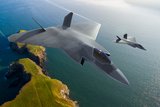
Canada has joined GCAP as an observer. (Image: BAE Systems)
July’s Farnborough International Airshow (FIA) 2026 recorded US$84.7 billion in deals after four trade days, according to organisers, with a record 1,636 exhibitors in attendance. US exhibitors took up 20,537m² across the halls, chalets and outdoor exhibition, or 35% of the site’s total exhibition space.
While uncrewed aerial systems were a significant theme of the show, several major crewed programmes and requirements also stepped into the spotlight, with notable developments including the UK’s search for a new jet trainer and a new observer entering the Global Combat Air Programme (GCAP).
Additionally, the Swedish Air Force outlined its future plans for Gripens as more aircraft are bound for Ukraine, and Raytheon UK unveiled Red Kite, a precision air-launched weapon based on the Stormbreaker design.
Related Articles
US Air Force to add new capabilities to its in-service and future T-7A fleet
GCAP remains bright spot in UK rearmament efforts as international prospects widen
FIA 2026: Raytheon UK offers Red Kite as ‘high-low mix’ weapon for RAF
The first of two Embraer KC-390 aircraft ordered by the Czech Air Force was on display at the show, just days before the Greek government committed to purchasing the same type.
Competitors move into position for the UK Hawk replacement
The UK is seeking to replace its Hawk T1/T2 fleet between the late 2020s and the early 2030s and while no formal bid competition has been launched as of July 2026, $486 million has been set towards the programme to date. Based on the possible timelines, this edition of FIA was possibly the last, or at least the best, chance for companies to publicly set out their stalls on home soil.
BAE Systems, which was the original equipment manufacturer for the Hawks, announced a teaming agreement with Boeing and Saab to advance their partnership on a next-generation pilot training offer for the UK, based on the T-7 Red Hawk.
The T‑7 is in flight testing ahead of service entry with the US Air Force (USAF), and an initial production order (Milestone C) was achieved in late April.
The aircraft was revealed in 2021, but the T-7 procurement has experienced multiple issues and is currently behind its initial planning, according to the US Government Accountability Office. The delays are reportedly caused by the need for additional engineering analysis and longer software development, in addition to problems with the aircraft escape system and projector. Other obstacles impacting its schedule included lower-than-anticipated aircraft availability, maintenance issues and lack of spare parts.

Steve Parker, president and CEO of Boeing Defense, Space & Security, played down the problems, saying: “I’ve got 30 aircraft coming through in various forms. We are going to be producing at quite a rate.”
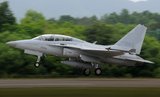
Another known competitor will be the Korea Aerospace Industries (KAI) T-50. As a proven solution that could be manufactured in the UK, the company claims the T-50/FA-50 light jet family is an “ideal” contender for the Royal Air Force’s (RAF) Hawk replacement requirement.
Shin Dong-Hak, VP of international business at the company, said: “The T-50 already has three options; one is a trainer...and it is also proven with a demonstration team.”
Shin said the T-50 can be produced in the UK and that the company is searching for a domestic industrial partner. He cited a need for 40 to 50 aircraft, although Shephard’s Defence Insight expects the number to be lower at 28. The higher number, however, may also take into account Red Arrows display team.
KAI is talking to Lockheed Martin about competing internationally, particularly in the UK, and is also looking at Australia’s Hawk replacement requirement.
GCAP takes the lead
The multinational Global Combat Air Programme (GCAP) took a major step forward during the airshow as Canada joined existing partners UK, Japan and Italy as an observer of the programme, with the only glum note being the potential impediments to Germany joining.
Leonardo CEO and general manager Lorenzo Mariani used a media briefing at FIA to argue that Canada’s newly confirmed status as GCAP’s first observer nation carried no real downside for the trilateral Italy-Japan-UK programme.
However, Mariani noted it could be difficult for Germany to follow Canada and become an observer, arguing that Berlin’s existing design maturity and industrial capability meant it would have little incentive to accept a lesser status than the founding three nations.
Any attempt by another industrial bloc to join the programme risked introducing delays, he said, at a moment when Italy, Japan and the UK remained fully committed to a 2035 in-service date.
Saudi Arabia is another country with a possible interest in joining GCAP, an effort partially driven by a desire to develop domestic defence manufacturing as part of Crown Prince Mohammed bin Salman’s Vision 30 strategy.
While Saudi’s entrance to the programme would provide access to a large reserve of capital, the nation’s ties to Russia and China have given rise to security concerns from other participants.
Sweden looks to secure Gripen’s future
Speaking the day before FIA, Swedish Air Force (SwAF) commander Maj Gen Jonas Wikman said Sweden had accelerated procurement of Taurus missiles and Gripen E capability as the force adjusts to NATO membership and rethinks its future combat air strategy.
Jonas said Sweden has brought forward the introduction of several capabilities as it reworks its air power concept around NATO membership, with offensive counter-air solutions – absent from a force historically optimised for defence – now among the SwAF’s highest priorities. As part of this, Sweden is reworking its procurement schedule with the Swedish Defence Materiel Administration (FMV) and industry partners to pull forward the introduction of the Taurus KEPD 350 long-range cruise missile by more than one year.
Wikman confirmed Sweden’s commitment to donate up to 16 Gripen C/D aircraft to Ukraine, alongside a separate order for 16 new-build Gripen E fighters, signed on 30 June 2026.
To offset the donated airframes, Sweden has ordered an additional 12 Gripen E aircraft for its own air force, taking its planned Gripen E fleet to 72 aircraft on top of the original 60-aircraft order placed in 2013.
At FIA, Saab’s corporate communications manager Conal Walker told Shephard that major new announcements are expected in about a month on Saab’s military programmes.
Czech presents first C-390 and Greece agrees to purchase
On static display at FIA was the first of two Embraer C-390 tactical transport aircraft for the Czech Air Force, the fourth operator to take the type, which featured a three-tone grey camouflage paint scheme. The aircraft was received just ahead of the show.
Meanwhile, Greece Defence Minister Nikos Dendias announced a decision on 23 July to buy three C-390s after approval by the Government Council for Foreign Affairs and Defence in a €600 million deal to replace its C-130H Hercules fleet.

Portugal signed a deal last year for an option for 10 C-390s with the Greek aircraft to be purchased through a government-to-government deal with Portugal. The first aircraft is expected to be delivered next year with the third aircraft in service by 2030 and there may be a follow-on order for a further three aircraft.
Hellenic Aerospace Industry signed a Memorandum of Understanding with Embraer in May covering support for C-390 operations.
Greece makes the number of C-390 customers an even dozen alongside Brazil, the Czech Republic, Portugal, the Netherlands, Austria, Slovakia, Sweden, South Korea, Lithuania, Uzbekistan and the UAE.
Raytheon unveils Red Kite precision weapon
Raytheon UK unveiled its new precision weapon, Red Kite, at FIA. It is the company’s first sovereign precision weapon fully designed and digitally engineered in the UK.
The company is aiming to position itself to expand its role as a design authority for the RAF beyond its long-running Paveway IV programme.
Red Kite reuses the airframe of Raytheon’s Stormbreaker, the glide bomb already integrated on the F-35B, F/A-18 and F-15 fighter aircraft, which is manufactured in Europe for export to the US.

Raytheon UK’s head of weapons Richard Gates said the programme deliberately avoided redesigning the airframe in order to draw on Stormbreaker’s manufacturing scale and integration maturity, instead concentrating UK investment on replacing the weapon’s internal subsystems.
Red Kite is intended to sit below top-tier, powered weapons such as SPEAR Cap 3 while offering substantially greater stand-off range than Paveway IV.
The company said the weapon is optimised primarily for Eurofighter Typhoon, with additional integration potential on the F-35, and claimed a multiple of Paveway IV’s range, though it declined to confirm specific figures.
Related Programmes in Defence Insight
Global Combat Air Programme [UK]
Related Equipment in Defence Insight
More from Farnborough International Airshow 2026 | View all news
-
Maximise survivability with advanced electronic warfare (video)
BAE Systems’ all-digital EW delivers 360-degree threat awareness in contested environments, boosts survivability, and cuts lifecycle costs.
-
British Army’s Project Corvus selection highlights new era of drone sovereignty
The UK’s choice of the Tekever AR5 for Project Corvus reflects a wider shift in military drone procurement towards solutions that centre on sovereignty and domestic production, moving away from overseas reliance.
-
FIA 2026: Honeywell Aerospace targets expansion following June spin-off
Honeywell Aerospace charted its growth strategy as a standalone company, with CEO Jim Currier pointing to record defence budgets and a $19 billion backlog as drivers of expansion.
-
FIA 2026: Malloy eyes NATO expansion and Australia for T-150 as it scales up technology
BAE Systems’ Malloy Aeronautics is seeking to expand the international customer base for its T-150 heavy-lift UAV, with NATO users beginning to adopt the platform and Australia identified as a key prospective market.