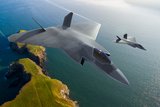
DARPA selects Lockheed Martin for ACE programme
ACE aims to better inform pilots with group-level situational awareness and coordinated targeting responsibility. (Photo: US DoD)
Lockheed Martin will develop full-scale experimentation platforms to implement Air Combat Evolution algorithms and technologies in this phase of the programme.


Lockheed Martin has been awarded an $11,7 million contract for the Air Combat Evolution (ACE) Technical Area 4 Phases 2 and 3.
The agreement includes the development of full-scale experimentation platforms capable of implementing the ACE algorithms and technologies.
The works will be carried out in Fort Worth, Texas and Tucson, Arizona, with an expected completion date of December 2023.
ACE is run by DARPA and aims to better inform pilots with group-level situational awareness and coordinated targeting responsibility.
ACE Technical Area 3 Phase 2, which focused on learning how to create a symbiosis between air battle managers and the AI-based battle management system, was run by Dynetics, a subsidiary of Leidos.
Dynetics developed a matured approach to battle management, where a single pilot can act as a commander for large-scale and collaborative air warfare.
Phase 1 carried out works on AI architecture design for large force battle management in a Mosaic Warfare construct.



More from Air Warfare
-
![AFA 2026: Swarm Aero eyes 2027 Gamera flight as Textron/Merlin reveal SkyCourier UX]()
AFA 2026: Swarm Aero eyes 2027 Gamera flight as Textron/Merlin reveal SkyCourier UX
Two new uncrewed aircraft concepts target very different US military requirements, from massed long-range strike to autonomous logistics. Shephard spoke with executives from Swarm Aero, Textron Aviation and Merlin Labs at this year's AFA Air, Space and Cyber conference to learn more about their capabilities.
-
![Could the next UAS market boom take place beyond the battlefield?]()
Could the next UAS market boom take place beyond the battlefield?
While the headlines remain dominated by the use of drones for combat operations in Ukraine and other conflicts, there are emerging use cases where the technology could usefully feed back into areas and missions outside the war zone.
-
![USAF eyes sensor and weapon upgrades as MH-139A Grey Wolf achieves IOC]()
USAF eyes sensor and weapon upgrades as MH-139A Grey Wolf achieves IOC
The Grey Wolf has entered operational service nearly three years later than originally planned, while new sustainment contracts indicate that some UH-1Ns could remain supported until 2031.
-
![Singapore’s interest in GCAP reflects its long-term approach to air power]()
Singapore’s interest in GCAP reflects its long-term approach to air power
A potential interest in joining GCAP is indicative of Singapore’s long-term and methodical approach to defence procurement and could benefit its local defence industry.