Boeing to integrate low-band jamming pod on Growlers
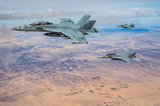
An EA-18G Growler aboard the USN aircraft carrier USS Theodore Roosevelt (Photo: USN/Mass Communication Specialist Seaman Ryan Kledzik)
Next Generation Low-Band Jammer to be installed aboard EA-18G aircraft as part of wider EW upgrade programme.


Boeing has received a contract to integrate the Next Generation Low-Band Jammer (NGJ-LB) electronic jamming pod on USN EA-18G Growler aircraft.
A $64.18 million deal from Naval Air Systems Command ‘provides non-recurring engineering support to integrate the Next Generation Jammer Low Band Pod System onto the EA-18G platform’, the DoD announced on 4 November.
It added: ‘These services include design and qualification of platform A-kit provision, aircraft/pod system physical interface analysis, wind tunnel test, ground vibration test, technical directive development and verification, and all logistics product data to support the program life cycle.’
Work will be performed at three US locations and will be completed in October 2026.
NGJ-LB is included in the broader EA-18G Block 2 EW upgrade programme, which also features mid-band and high-band jammers.
L3Harris is under contract from the USN to develop the NGJ-LB pod, which will be capable of engaging threats transmitting across a 500MHz to 2GHz waveband.
Related Equipment in Defence Insight

More from Air Warfare
-
![Extending mission readiness: where XR adds real value in pilot, crew and maintenance training]()
Extending mission readiness: where XR adds real value in pilot, crew and maintenance training
Extended reality (XR) is becoming increasingly relevant in military aviation training, adding a flexible layer to an integrated ecosystem spanning the pilot, crew, and maintenance domains.
-
![August crewed air review: KC-390 momentum builds as demand in the tanker market grows]()
August crewed air review: KC-390 momentum builds as demand in the tanker market grows
The KC-390 is building a growing international operator base, but competition in the transport and tanker market is increasingly likely to depend on interoperability, commonality and the strength of supporting ecosystems. Meanwhile, Boeing’s KC-46 and Airbus’s A330 also gained ground in August.
-
![Iran war exposes the limits of US military mass]()
Iran war exposes the limits of US military mass
As the Straits of Hormuz continue to witness military action of various types, what does this mean for combat air and air defence planners in the region and beyond?