Venezuelan Navy OPV sinks after collision with passenger ship


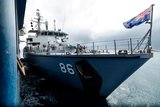
Venezuelan Navy OPV Naiguatá (GC-23) sank on 30 March after colliding with a Portuguese-registered Colombian passenger ship, RCGS Resolute.
The incident occurred at approximately 00:45, some 13.3nm from Isla de Tortuga.
A statement from Columbia Cruise Services, operator of RCGS Resolute, the vessel was ‘subject to an act of aggression by the Venezuelan Navy in international waters’.
The Naiguatá, a Guaicamacuto-class patrol boat built in Spain, radioed the passenger liner questioning their intentions and the Venezuelan OPV requested that Resolute follow it to Puerto Moreno. After firing gun shots, Naiguatá then collided with the passenger ship.
Naiguata began to take on water after sustaining significant damage caused by the ice-strengthened bulbous bow of Resolute.
Columbia Cruise Services said that their vessel waited nearby for more than an hour before being told that its assistance would not be required by the Maritime Rescue Coordination Centre (MRCC) in Curaçao.
The MRCC’s attempts to contact the Venezuelan OPV were unanswered.
Related Equipment in Defence Insight


More from Naval Warfare
-
![Quantum Systems enters maritime domain with Baltic-focused USV and UUV]()
Quantum Systems enters maritime domain with Baltic-focused USV and UUV
Quantum Systems has launched into the maritime domain with Seavex and Subvex, aiming to close a Baltic Sea ISR gap opened by infrastructure sabotage.
-
![Suppliers await next step in Australia’s mine warfare transition]()
Suppliers await next step in Australia’s mine warfare transition
Australia’s mine countermeasure capability remains in flux as the Huon-class nears retirement, but accelerated investment in autonomous systems is opening a path for industry.
-
![Can the US Navy ask Indo-Pacific allies to do more while training with them less?]()
Can the US Navy ask Indo-Pacific allies to do more while training with them less?
As the Iran War draws US ships and marine corps units away from the Indo-Pacific, curtailed exercises and a temporary carrier gap are exposing tensions between Washington’s demand for more self-reliant allies and the joint training needed to realise that ambition.
-
![How could Rheinmetall’s GMF 140 fit with ongoing programmes in North America?]()
How could Rheinmetall’s GMF 140 fit with ongoing programmes in North America?
With Canada committed to its River-class replacement and the USN pursuing a lower-cost frigate, Rheinmetall will need to demonstrate where the GMF 140 can fill a capability gap in the North American fleet.
-
![Australian industry programme builds pipeline for Virginia-class sustainment]()
Australian industry programme builds pipeline for Virginia-class sustainment
Australian businesses can now bid to support Virginia-class submarine sustainment in Western Australia, as momentum around the Henderson Defence Precinct also builds.