US Navy goes shopping for maritime uncrewed capabilities
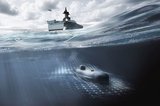
A US Navy Global Autonomous Reconnaissance Craft. (Photo: US Navy)
The US Navy has been seeking suppliers to design and build diverse types of aerial, surface and underwater autonomous capabilities, as well as solutions to support their operation.


The US Navy (USN) is seeking suppliers for maritime uncrewed platforms while preparing to start multiple development and acquisition efforts in FY2026. It has recently published several requests for information (RfIs) and sources sought notices involving aerial, surface and underwater capabilities and operational support solutions.
Only in September, the branch issued solicitations for an ocean explorer (OEX) large underwater vehicle, a submarine rescue mission platform to be used as a mothership, a remote minehunting (RMH) module to be operated from Mine Countermeasures Unmanned Surface Vehicles (MCM USV) and a Tactical Resupply Unmanned Aircraft System (TRUAS).
In the case of
Our news & analysis is now part of Defence Insight®
A Basic-level or higher Defence Insight subscription is now required to view this content.


More from Naval Warfare
-
![China’s mineral processing dominance exposes naval supply chain vulnerabilities]()
China’s mineral processing dominance exposes naval supply chain vulnerabilities
Competition for critical minerals, and China’s dominance of their processing, is emerging as a decisive factor in future naval procurement programmes.
-
![Suppliers await next step in Australia’s mine warfare transition]()
Suppliers await next step in Australia’s mine warfare transition
Australia’s mine countermeasure capability remains in flux as the Huon-class nears retirement, but accelerated investment in autonomous systems is opening a path for industry.
-
![Can the US Navy ask Indo-Pacific allies to do more while training with them less?]()
Can the US Navy ask Indo-Pacific allies to do more while training with them less?
As the Iran War draws US ships and marine corps units away from the Indo-Pacific, curtailed exercises and a temporary carrier gap are exposing tensions between Washington’s demand for more self-reliant allies and the joint training needed to realise that ambition.
-
![How could Rheinmetall’s GMF 140 fit with ongoing programmes in North America?]()
How could Rheinmetall’s GMF 140 fit with ongoing programmes in North America?
With Canada committed to its River-class replacement and the USN pursuing a lower-cost frigate, Rheinmetall will need to demonstrate where the GMF 140 can fill a capability gap in the North American fleet.
-
![Australian industry programme builds pipeline for Virginia-class sustainment]()
Australian industry programme builds pipeline for Virginia-class sustainment
Australian businesses can now bid to support Virginia-class submarine sustainment in Western Australia, as momentum around the Henderson Defence Precinct also builds.