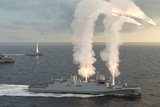
US Navy funds Austal construction of new LCS


The US Navy has funded the construction of two Littoral Combat Ships (LCS), LCS 22 and LCS 24, by Austal. The company announced the funding on 2 April.
The two vessels will be the ninth and tenth Independence-class LCS built by Austal. The company has a ten-vessel contract with the navy. The funding of the two ships adds around $691 million to its order book.
In addition to funding the construction of the two LCS under contract, the navy also included an option to construct the additional vessel LCS 26. This option may be exercised in 2016, and it would bring the total number of Independence-class LCS constructed by Austal to 13, 11 of which saw Austal act as prime contractor and two as a subcontractor.
Austal currently has seven LCS under various construction stages, including the USS Jackson (LCS 6), which has begun sea trials and is expected to be delivered by around mid-2015, and the USS Montgomery (LCS 8), which is expected to be delivered by the end of the year.

You may also like

More from Naval Warfare
-
![How France’s SNLE 3G programme is reshaping the naval nuclear industrial base]()
How France’s SNLE 3G programme is reshaping the naval nuclear industrial base
Extending far beyond a four-submarine replacement programme, France’s ballistic missile submarine effort is a decades-long industrial effort designed to preserve the country’s ability to build and sustain nuclear-powered strategic platforms.
-
![China’s mineral processing dominance exposes naval supply chain vulnerabilities]()
China’s mineral processing dominance exposes naval supply chain vulnerabilities
Competition for critical minerals, and China’s dominance of their processing, is emerging as a decisive factor in future naval procurement programmes.
-
![Suppliers await next step in Australia’s mine warfare transition]()
Suppliers await next step in Australia’s mine warfare transition
Australia’s mine countermeasure capability remains in flux as the Huon-class nears retirement, but accelerated investment in autonomous systems is opening a path for industry.
-
![Can the US Navy ask Indo-Pacific allies to do more while training with them less?]()
Can the US Navy ask Indo-Pacific allies to do more while training with them less?
As the Iran War draws US ships and marine corps units away from the Indo-Pacific, curtailed exercises and a temporary carrier gap are exposing tensions between Washington’s demand for more self-reliant allies and the joint training needed to realise that ambition.
-
![How could Rheinmetall’s GMF 140 fit with ongoing programmes in North America?]()
How could Rheinmetall’s GMF 140 fit with ongoing programmes in North America?
With Canada committed to its River-class replacement and the USN pursuing a lower-cost frigate, Rheinmetall will need to demonstrate where the GMF 140 can fill a capability gap in the North American fleet.