Ultra supports Australia’s Hobart-class destroyer sonar systems
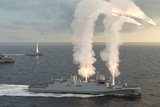
All three Hobart-class ships are in service. (Photo: RAN)
The contract will ensure the destroyers’ sonar systems continue to meet the needs of the Royal Australian Navy (RAN).


Together with Raytheon Australia, Ultra has entered into an agreement for the fifth year of in-service support for Australia’s Hobart-class guided-missile destroyer.
The contract will ensure the ships’ integrated sonar system, which comprises a hull-mounted sonar and towed variable depth sonar joined by a processing suite, continues to support RAN requirements.
Ultra Sonar Systems president Bernard Mills said: ‘Ultra is committed to work closely with Raytheon and our other support partners to maximise the availability and operational capability of the Hobart Class Destroyer for the Royal Australian Navy.’
Last month, Shephard reported the third RAN Hobart-class destroyer, HMAS Sydney, had reached full operational capability.
Shephard Defence Insight notes the Hobart-class vessels have space for an S-70B Seahawk helicopter that will be replaced by the MH-60R. The ships have a displacement of 7,000t and have a length of 146.7m.
The ships can reach a top speed of 28kt with a range of 5,000nm and have a crew of 180.



More from Naval Warfare
-
![Suppliers await next step in Australia’s mine warfare transition]()
Suppliers await next step in Australia’s mine warfare transition
Australia’s mine countermeasure capability remains in flux as the Huon-class nears retirement, but accelerated investment in autonomous systems is opening a path for industry.
-
![Can the US Navy ask Indo-Pacific allies to do more while training with them less?]()
Can the US Navy ask Indo-Pacific allies to do more while training with them less?
As the Iran War draws US ships and marine corps units away from the Indo-Pacific, curtailed exercises and a temporary carrier gap are exposing tensions between Washington’s demand for more self-reliant allies and the joint training needed to realise that ambition.
-
![How could Rheinmetall’s GMF 140 fit with ongoing programmes in North America?]()
How could Rheinmetall’s GMF 140 fit with ongoing programmes in North America?
With Canada committed to its River-class replacement and the USN pursuing a lower-cost frigate, Rheinmetall will need to demonstrate where the GMF 140 can fill a capability gap in the North American fleet.
-
![Australian industry programme builds pipeline for Virginia-class sustainment]()
Australian industry programme builds pipeline for Virginia-class sustainment
Australian businesses can now bid to support Virginia-class submarine sustainment in Western Australia, as momentum around the Henderson Defence Precinct also builds.
-
![South Korea, Japan and Turkey vie for US shipbuilding access in future frigate contest]()
South Korea, Japan and Turkey vie for US shipbuilding access in future frigate contest
Washington’s search for a foreign-built frigate could hand South Korea, Japan and Turkey a larger prize than a double-hull order: a foothold inside the US shipbuilding industrial base.