UAE Coast Guard orders 10 OPVs for $434 million
The 10 P51MR-class order by the UAE Coast Guard will be build in Italy and the UAE. (Photo: EDGE Group)
A deal to supply 10 P51MR-class 51m offshore patrol vessels to the UAE Coast Guard was proceeded by the signing of an Abu Dhabi-based JV between Fincantieri and EDGE.


The UAE Coast Guard has ordered 10 P51MR-class 51m offshore patrol vessels (OPVs) for €400 million (US$434 million).
Based on the Saettia-class, P51MR-class OPVs have been designed for high modularity and stability in rough seas. They will also offer a low-radar signal signature and what EDGE described as “high operational flexibility”.
EDGE Group chairman Faisal Al Bannai said the OPVs would be built at the company’s shipyards in Abu Dhabi and at Fincantieri’s facilities in Italy.
Related Articles
Fincantieri launches sixth Multipurpose Offshore Patrol ship for Italian Navy
Italy’s Fincantieri and UAE’s Edge Group sign for naval joint venture
How UAE defence giant EDGE Group plans to double its exports
The announcement of the deal followed the signing of an agreement between the UAE defence conglomerate and the Italian shipbuilding giant to launch an Abu Dhabi-based shipbuilding joint venture (JV) called MAESTRAL.
EDGE will hold a 51% stake in the venture, which was first announced in February 2024, and will be awarded “prime rights” to orders on a commercial pipeline currently valued at €30 billion. EDGE will be given access to all non-NATO orders along with what it termed “a number of strategic orders placed by selected NATO member countries”.
“MAESTRAL will concentrate on sales, commercial operations and engineering for design and service, while providing valuable employment opportunities for highly skilled local and international talent,” EDGE noted.
Al Bannai said the JV with Fincantieri underscored the UAE company’s “strategy of international export growth through mutually beneficial partnerships”, as well as the exchange of knowledge and expertise.
“It also opens up opportunities for MAESTRAL to promote an extensive portfolio of diverse maritime solutions, including a complete series of technologically advanced vessels, to navies and coast guards around the world,” he added.
Fincantieri CEO and managing director Pierroberto Folgiero said the JV would allow the Italian shipbuilder to seize opportunities in the UAE and develop its commercial capabilities “in the international defence sector in connection with Abu Dhabi export platform”.
Over the weekend, the launching ceremony for the logistic support ship (LSS) Atlante took place forming part of the Italian Navy’s fleet renewal plan.
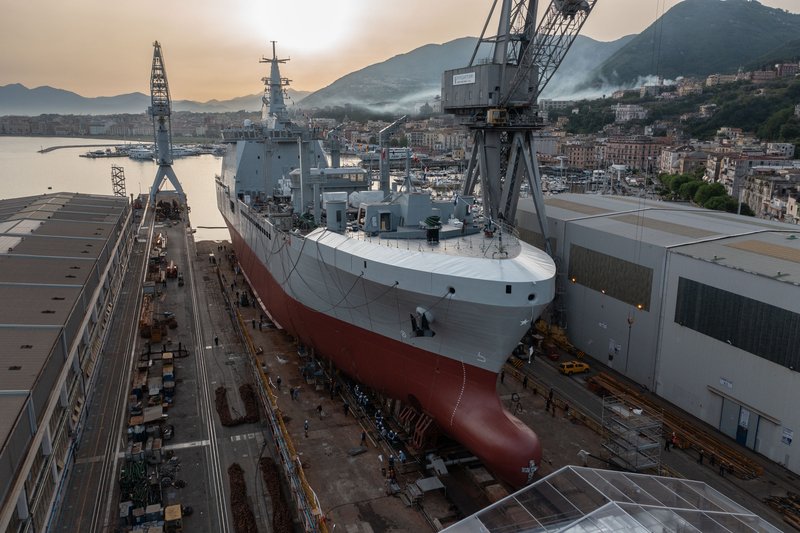
Once completed, Atlante will be able to accommodate 235 crew and specialists. (Photo: Giovanni Rasio)
Atlante, scheduled for a 2025 delivery, will become the second unit of its type built for the Italian Navy following the delivery of Vulcano by Fincantieri in 2021. The ship will weigh approximately 27,000 tonnes and measure 193m in length.
The vessel will provide logistical, intelligence and electronic warfare equipment support to the Italian Navy, as well as offering non-military activity support via humanitarian and rescue aid operations.
Related Programmes in Defence Insight
Logistic Support Ship (2) [Italy]
Related Equipment in Defence Insight


More from Naval Warfare
-
![Industry sees opportunity in Australia’s shift to networked undersea warfare]()
Industry sees opportunity in Australia’s shift to networked undersea warfare
Australia’s new defence innovation strategy indicates a shift from platform-centric to network-centric undersea warfare, with Ocius and Anduril Industries pointing to fast-growing opportunities for local industry.
-
![Asia-Pacific emerges as the largest export market for US-made USVs]()
Asia-Pacific emerges as the largest export market for US-made USVs
Asian customers have placed one of the largest known international purchases of US-built uncrewed surface vessels, highlighting accelerating regional demand for autonomous maritime capabilities and distributed naval operations.
-
![Europe’s naval contractors benefit from growing refit and upgrade demand]()
Europe’s naval contractors benefit from growing refit and upgrade demand
Rheinmetall’s order to modernise the German Navy frigate Bayern points to a wider European shift towards extending warship service life as new-build programmes face delay.