Italy’s Fincantieri and UAE’s Edge Group sign for naval joint venture
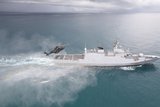
ADSB has been building a BR71 MKII corvette for Angola. (Image: Edge Group)
Edge’s joint venture with Fincantieri will boost Abu Dhabi Ship Building’s growth potential and open the door to the region for its Italian partner.


UAE conglomerate Edge Group and Italian shipbuilder Fincantieri have signed a naval joint venture (JV) agreement which, according to the companies, has a commercial pipeline worth as much as €30 billion (US$32.4 billion).
The UAE company, which owns Abu Dhabi Ship Building (ADSB), will hold a 51% stake in the JV with management direction provided by Fincantieri.
The Abu Dhabi-based JV will mostly focus on non-NATO orders, especially leveraging on government-to-government arrangements and export credit financing packages, along with a number of strategic orders placed by select NATO member countries.
While the JV will have a role to play in enhancing Edge’s ability to design and build frigates and other large vessels, “the JV also harbours ambitions to develop an underwater program for mid-size submarines”, according to an ADSB statement.
Fincantieri has a substantial book of naval orders, both for Italy, other countries and as part of multinational programmes such as FREMM (Frégate européenne multi-mission/ Fregata europea multi-missione).
The company has also been active in the Middle East, including manufacturing two OPVs for the Qatari Emiri Navy as part of a larger seven-vessel €4 billion ($4.67 billion) contract and has been bidding for Saudi Arabia’s LPD requirement.
In February 2023, ADSB signed a significant deal with Angola to supply the African nation with BR71 MKII corvettes and small watercraft. In May 2021, it signed an AED3.5 billion (US$952.8 million) contract with the UAE to build four Falaj 3-class offshore patrol vessels (OPVs) for the UAE Navy.
Related Programmes in Defence Insight




More from Naval Warfare
-
![Italy sets course for a decade of sustained naval investment]()
Italy sets course for a decade of sustained naval investment
The country's long-term growth plan to overhaul its fleets well into the 2030s could open the door to an array of opportunities for suppliers.
-
![FNSS looks to put uncrewed vehicles at the front of amphibious assaults]()
FNSS looks to put uncrewed vehicles at the front of amphibious assaults
The new platform is designed to put reconnaissance, obstacle clearance and fire support ahead of the crewed force in a contested landing.
-
![Ireland’s strategic cable role grows as naval capacity falls behind]()
Ireland’s strategic cable role grows as naval capacity falls behind
Around 75% of the northern hemisphere’s undersea cables transit Irish waters, but personnel shortfalls and a stalled multirole vessel programme leave patrol capacity in question.