Second Belgian mine counter-measure ship launched
Tournai is the third mine countermeasure vessel of the Belgian-Dutch remote mine countermeasure (rMCM) programme. (Photo: Naval Group)
Twelve new Mine Countermeasures Vessels (MCMVs) are being built to replace the Tripartite-class MCMV. The programme is a joint Dutch-Belgian procurement and a contract was awarded to Belgium Naval Robotics (BNR) in 2019.


The Belgian Navy’s second new mine countermeasure ship, Tournai, was launched on 2 July with an expectation that it will be delivered in 2026.
Tournai is the third of the twelve mine countermeasure vessels in the Belgian-Dutch rMCM programme. The first ship in the series, Oostende, destined for the Belgian Navy, was launched on 29 March 2023. The second, Vlissingen, destined for the Royal Netherlands Navy, was launched on 19 October 2023.
The fourth in the series, Scheveningen, the second vessel for the Dutch Navy, was laid down on 19 July 2023 and is scheduled to be launched in December 2024.
Related Articles
rMCM launch and recovery system undergoes tests
First Belgian-Dutch rMCM vessel launched
Dutch navy launches new rMCM vessel
Delivery of Oostende is scheduled for summer 2025 in Zeebrugge, Belgium. Deliveries of the other ships will then be staggered until mid-2030, at a rate of two a year.
In September 2023, a Memorandum of Understanding (MoU) was signed between France, Belgium and the Netherlands, allowing France to use the design of the rMCM ships to equip the French Navy with six ships.
France’s Naval Group is overall architect and prime contractor and responsible for the design of the ships, overall integration, testing and commissioning of the mission system (combat system and mine countermeasures system).
Kership, a joint venture between Naval Group and Piriou, is the industrial prime contractor for the 12 ships, which are being built in Concarneau and Lanester.
The main strength of the ships is what Naval Group refers to as “the toolbox” which consist of the capacity to operate surface uncrewed surface vessels (vessels of around 12m and 18t), underwater uncrewed systems and UAS.
Related Equipment in Defence Insight



More from Naval Warfare
-
![US Navy $76.6bn award provides stability for submarine production]()
US Navy $76.6bn award provides stability for submarine production
The US Department of War’s US$76.6 billion Columbia-and Virginia-class submarine contract gives industry demand certainty as Washington seeks to rebuild its shipbuilding base.
-
![Dreadnought Phase 4 opens £2.5 billion supply chain opportunity]()
Dreadnought Phase 4 opens £2.5 billion supply chain opportunity
The UK government’s £8.4 billion Dreadnought Phase 4 investment sets aside £2.5 billion for the wider submarine supply chain, opening new work beyond BAE Systems’ prime contract.
-
![A400M trial demonstrates airborne deployment of uncrewed surface vessel]()
A400M trial demonstrates airborne deployment of uncrewed surface vessel
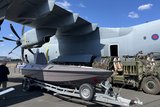
Kraken Technology Group’s A400M airdrop of a K3 Scout uncrewed surface vessel points to a new way for navies to insert USVs into contested waters, bypassing ports and motherships.
-
![Babcock onshores 85% of Canada’s submarine supply chain as it eyes future CPSP programme]()
Babcock onshores 85% of Canada’s submarine supply chain as it eyes future CPSP programme
By moving most of the Royal Canadian Navy’s submarine supply chain into Canada, Babcock Canada is driving to strengthen sovereign sustainment capabilities while preparing to compete to maintain the future Canadian Patrol Submarine Project.