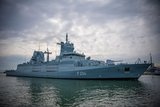
Royal Navy experiments ship Patrick Blackett gets into its stride
XV Patrick Blackett alongside HMS President in London. (Photo: author)
Having already embarked two experimental capabilities and achieved certification, the UK RN’s research ship XV Patrick Blackett is expanding the horizon for the navy’s efforts to test and trial new technologies.


Moored in London, the UK RN’s XV Patrick Blackett – owned by its internal technology and lethality accelerator NavyX – is a Swiss Army knife for the navy in its efforts to test, trial and develop new technologies for the current and future fleet.
Speaking to Shephard from the bridge, CO Cdr Michael Hutchinson said the vessel recognised that the navy had struggled with having a dedicated platform for experimentation.
Before procuring the ship from Damen and fitting it out for trials and experimentation, the RN had trialled new capabilities onboard operational warships, which with pressing schedules, made finding time
Our news & analysis is now part of Defence Insight®
A Basic-level or higher Defence Insight subscription is now required to view this content.


More from Naval Warfare
-
![Australian industry programme builds pipeline for Virginia-class sustainment]()
Australian industry programme builds pipeline for Virginia-class sustainment
Australian businesses can now bid to support Virginia-class submarine sustainment in Western Australia, as momentum around the Henderson Defence Precinct also builds.
-
![Ukraine’s new long-range 12m autonomous vessel can deploy other drones]()
Ukraine’s new long-range 12m autonomous vessel can deploy other drones
Ukraine’s UForce unveiled the MV11 uncrewed surface vessel, designed to launch and support other naval drones at sea, fuelling debate over the future of autonomous maritime task groups.
-
![German Navy’s Israeli missile test points to deepening defence-industrial ties]()
German Navy’s Israeli missile test points to deepening defence-industrial ties
The test-firing of an Israel Aerospace Industries LORA ballistic missile from a German vessel highlights the Bundeswehr’s focus on speed to capability as it trials Israel’s operationally proven technology.