Raytheon wins US Navy Phalanx and SeaRAM work


Raytheon will upgrade 19 Phalanx Close-in Weapon Systems and supply four SeaRAM Anti-ship Missile Defence Systems for the US Navy under a $136.2 million contract announced on 11 September.
In addition to upgrading the Phalanx systems, Raytheon will remanufacture and overhaul the rapid-fire, computer-controlled radar and 20 mm gun systems. Phalanx automatically acquires, tracks and destroys enemy threats that have penetrated all other ship defence systems.
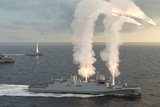
SeaRAM enlarges Phalanx’s keep-out range against evolving anti-ship missiles, rotary- and fixed-wing aircraft and other threats. It uses advanced Phalanx Block 1B sensors and replaces the gun with an 11-round Rolling Airframe Missile guide. SeaRAM is aboard the USS Independence (LCS 2) and USS Coronado (LCS 4).
Rick Nelson, vice president of Raytheon Missile Systems’ Naval and Area Mission Defense product line, said: ‘Phalanx is a vital ship self-defence system, providing the critical inner-layer of protection to sailors, marines and ships. With SeaRAM comes a significant extension of that inner-layer battlespace and the capacity to effectively engage multiple high-performance threats.
‘Raytheon’s ability to remanufacture Phalanx equivalent to new manufacture condition - in appearance, operation and performance - provides a significant cost savings to our customers.’
This contract includes a $94.8 million option for FY14 covering an additional 12 Phalanx and four SeaRAM systems. The option, if exercised, would bring the cumulative value of the contract to $231 million.


More from Naval Warfare
-
![Can the US Navy ask Indo-Pacific allies to do more while training with them less?]()
Can the US Navy ask Indo-Pacific allies to do more while training with them less?
As the Iran War draws US ships and marine corps units away from the Indo-Pacific, curtailed exercises and a temporary carrier gap are exposing tensions between Washington’s demand for more self-reliant allies and the joint training needed to realise that ambition.
-
![How could Rheinmetall’s GMF 140 fit with ongoing programmes in North America?]()
How could Rheinmetall’s GMF 140 fit with ongoing programmes in North America?
With Canada committed to its River-class replacement and the USN pursuing a lower-cost frigate, Rheinmetall will need to demonstrate where the GMF 140 can fill a capability gap in the North American fleet.
-
![Australian industry programme builds pipeline for Virginia-class sustainment]()
Australian industry programme builds pipeline for Virginia-class sustainment
Australian businesses can now bid to support Virginia-class submarine sustainment in Western Australia, as momentum around the Henderson Defence Precinct also builds.
-
![South Korea, Japan and Turkey vie for US shipbuilding access in future frigate contest]()
South Korea, Japan and Turkey vie for US shipbuilding access in future frigate contest
Washington’s search for a foreign-built frigate could hand South Korea, Japan and Turkey a larger prize than a double-hull order: a foothold inside the US shipbuilding industrial base.
-
![Japan’s FY2027 budget bets on stand-off systems to offset demographic decline]()
Japan’s FY2027 budget bets on stand-off systems to offset demographic decline
Japan’s FY2027 defence budget backs stand-off strike, a 17-aircraft MQ-9B buy and a declared bid to lead the world in uncrewed maritime assets, alongside new frigates, submarines and support ships.
-
![Russia’s uncrewed boat portfolio hints at future naval demand]()
Russia’s uncrewed boat portfolio hints at future naval demand
Ukrainian intelligence has catalogued more than 20 Russian uncrewed surface vessels, revealing a portfolio weighted towards mine warfare and logistics, with implications for Western naval investment.