From surface to seabed: Fincantieri takes on a new challenge
Underwater is emerging as the global geopolitical domain, a crossroads between new needs and technological acceleration. While 80% of the sea floor and 98% of the abyssal seabed remain unexplored (Mars’ and Jupiter’s surfaces are better known than our oceans), human well-being relies on underwater assets and resources.


Enjoy free access to this sponsored article, all content provided by Fincantieri.
In the next century, 40% of food will come from the sea floor, while oil, gas, minerals and rare earth elements will continue to play a crucial role. With the transition to green energy, offshore wind and floating solar farms have become critical. Global data traffic heavily depends on subsea cables, which will span 1.7 million kilometres around the globe by 2027. The worldwide electricity market is projected to be worth approximately 25 billion euros in 2028, with the APAC region and Europe driving 60% of total demand.
Thanks to its vertically integrated business model, Fincantieri is uniquely positioned to design, build, integrate and operate all the key components of a new underwater ecosystem and can lead this transformation and address new challenges across domains by leveraging its history, assets and vision, providing expertise across sectors and applying a holistic approach.
The Group is evolving its business mix to support growth and profitability, with a strong focus on underwater systems. Fincantieri is investing heavily in this segment, to the extent that revenues are expected to double their contribution to the overall business within the next three years. Here, Fincantieri is leveraging its unique expertise in conventional technologies, such as submarines, effectors and sonar, to expand into a broader underwater ecosystem, combining conventional products with innovative technologies, extending applications beyond defence into the dual-use and commercial domains and providing comprehensive solutions for a wide range of clients.
Underwater ecosystem
Underwater has become a market comprising an ecosystem of technologies, which addresses a wide range of needs, from defence (mines, submarines or seabed warfare) to dual-use (surveillance, patrol, monitoring) to commercial (construction, repair, maintenance, deep-sea mining, aquaculture). The growing role of dual-use players is particularly notable, as they are recognised as better, cheaper, and faster.
Multiple development factors are pushing for sectoral leaders to emerge and Fincantieri is the incumbent player taking the role of market orchestrator, aiming to be a “one-stop shop” for the industry, supplying end-to-end turnkey solutions, vertically integrating core technologies and driving innovation.
Fincantieri has already taken key strategic steps to secure this role thanks to acquisitions and partnerships, which have led to the establishment of a new internal Underwater Hub to drive business and product development and deliver a portfolio designed to address market needs. The Underwater Hub will act as a single entry point for clients and push synergic tech development. It gathers together Fincantieri’s historical submarine expertise, along with WASS Submarine Systems, IDS Ingegneria Dei Sistemi and Remazel Engineeriing.
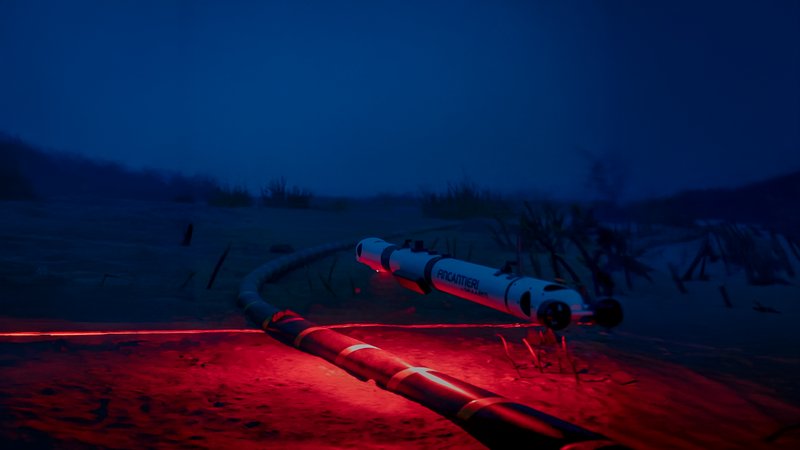
The offering of the Hub, in addition to submarines, sonar, torpedoes, and countermeasures, will be strengthened through the commercialisation of unconventional underwater solutions. This capability package includes modular and scalable “systems of systems” for:
harbour and critical maritime infrastructure monitoring, surveillance and protection, including active/passive hydrophone barriers, unmanned vehicles equipped with underwater imaging sensors, launch and recovery systems, controlled and managed by the Underwater Management System, an extension of the Unmanned Management System described below;
transforming a naval platform into a “mother ship” from which autonomous drones can be deployed and operated, thanks to equipment physically and functionally integrated from the earliest stages of vessel design, including the Unmanned Management System, an innovative multi-domain C3 (command, control, communication) suite developed by IDS.
Key components
Fincantieri’s ambition is to become a specialist in the underwater dimension, including shallow seas such as those in Southeast Asia, the Black Sea and the Middle East. These are all highly attractive markets that the company can approach by counting on solid long-standing experience, relying on the expertise gained from building 180 submarines since 1900.
Fincantieri has the ability in its DNA to bring together civil and military expertise with high-value technological solutions, and this dual nature makes it the catalyst for a national underwater production ecosystem, ensuring technological osmosis with positive effects on both the economy and the safety of the underwater environment, and also enhancing national excellence.




More from Industry Spotlights
-
![Orchestrating operational readiness across every defence domain]()
Orchestrating operational readiness across every defence domain
Are all systems ready for the next mission? Have upgrades been applied? Are all assets aligned to deploy together, on time and fully prepared? In modern defence operations, readiness is no longer measured platform by platform. It is measured by how well people, assets, data and decisions move together — across land, sea and air.
-
![Extending mission readiness: where XR adds real value in pilot, crew and maintenance training]()
Extending mission readiness: where XR adds real value in pilot, crew and maintenance training
Extended reality (XR) is becoming increasingly relevant in military aviation training, adding a flexible layer to an integrated ecosystem spanning the pilot, crew, and maintenance domains.
-
![Dominating the spectrum: ASELSAN’s EW capabilities take center stage at MSPO 2026]()
Dominating the spectrum: ASELSAN’s EW capabilities take center stage at MSPO 2026
ASELSAN is showcasing its advanced electronic warfare (EW) capabilities at MSPO 2026, highlighting technologies designed to detect, analyse, disrupt and deceive threats across increasingly contested electromagnetic environments.
-
![“Creating a decision advantage”: how C-UAS is evolving to reduce the operator burden]()
“Creating a decision advantage”: how C-UAS is evolving to reduce the operator burden
In Conversation… Speaking to Shephard’s Gerrard Cowan, Dr Brian Shand, Director – Advanced Concepts & Technology at L3Harris, explains how, as operators face growing numbers of low-cost drones, C-UAS providers must focus on reducing operator workload, transforming fragmented sensor data into effective decision-making.
-
![Shield the warfighter, win the fight (video)]()
Shield the warfighter, win the fight (video)
BAE Systems’ Intrepid Shield™ approach delivers full-spectrum electromagnetic protection to detect, exploit, and counter advanced threats.
-
![How joint ventures are expanding Rheinmetall's munitions portfolio (video)]()
How joint ventures are expanding Rheinmetall's munitions portfolio (video)
Roman Köhne, CEO of Rheinmetall's Weapon and Ammunition Division, discusses the company's announcements at Eurosatory 2026, including developments in defence technology, precision systems, industrial partnerships and future capability programmes.