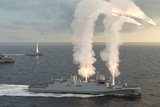
Raytheon and MDA go green with X-Band radar upgrade
Sea Based X-Band radar. (Photo: USN)
A new redesigned, environmentally friendly cooling system is set to improve the Sea-Based X-Band Radar’s (SBX) reliability and reduce its carbon footprint.


Raytheon Missiles & Defense partnered with the US Missile Defence Agency (MDA) to redesign the cooling system using environmentally friendly materials, decreasing energy loads and greenhouse gas emissions.
The new design will reduce the annual energy consumption of SDX by an estimated 4,346,000 kilowatt-hours. Decreasing the system’s reliance on diesel generators is expected to reduce carbon emissions by an estimated 17,786t per annum.
Kevin Ryan, executive director for strategic sensor systems at Raytheon Missiles & Defense, said: ‘SBX is one of the most powerful missile defence radars deployed today,
‘We were able to decarbonize and reduce the environmental impact of the system without sacrificing performance.’
Raytheon said the new design improves reliability by increasing redundancy by 150 per cent.
The company added that operational availability and readiness were increased by reducing ‘minimizing’ system failures.
The nine-storey tall SBX is the world’s largest phased array, electro-mechanically steered X-band radar.

SBX Infographic. (Photo: Raytheon Missiles & Defense.)




More from Naval Warfare
-
![Suppliers await next step in Australia’s mine warfare transition]()
Suppliers await next step in Australia’s mine warfare transition
Australia’s mine countermeasure capability remains in flux as the Huon-class nears retirement, but accelerated investment in autonomous systems is opening a path for industry.
-
![Can the US Navy ask Indo-Pacific allies to do more while training with them less?]()
Can the US Navy ask Indo-Pacific allies to do more while training with them less?
As the Iran War draws US ships and marine corps units away from the Indo-Pacific, curtailed exercises and a temporary carrier gap are exposing tensions between Washington’s demand for more self-reliant allies and the joint training needed to realise that ambition.
-
![How could Rheinmetall’s GMF 140 fit with ongoing programmes in North America?]()
How could Rheinmetall’s GMF 140 fit with ongoing programmes in North America?
With Canada committed to its River-class replacement and the USN pursuing a lower-cost frigate, Rheinmetall will need to demonstrate where the GMF 140 can fill a capability gap in the North American fleet.
-
![Australian industry programme builds pipeline for Virginia-class sustainment]()
Australian industry programme builds pipeline for Virginia-class sustainment
Australian businesses can now bid to support Virginia-class submarine sustainment in Western Australia, as momentum around the Henderson Defence Precinct also builds.
-
![South Korea, Japan and Turkey vie for US shipbuilding access in future frigate contest]()
South Korea, Japan and Turkey vie for US shipbuilding access in future frigate contest
Washington’s search for a foreign-built frigate could hand South Korea, Japan and Turkey a larger prize than a double-hull order: a foothold inside the US shipbuilding industrial base.