RAM Block 2 completes first phase developmental testing


Raytheon has announced that its Rolling Airframe Missile Block 2 has completed the first series of developmental and operational testing (DT/OT) by the US Navy.
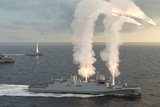
The tests saw the RAM Block 2 missiles successfully engage two targets in tactical dual-salvo scenarios designed to demonstrate the advanced missile’s defensive capabilities, with all four RAM Block 2 missiles meeting test objectives. The at-sea DT/OT testing was conducted from the US Navy’s Self-Defense Test Ship.
The testing is part of the work being carried out to fulfil the low-rate production contract awarded to Raytheon and its manufacturing partner, RAMSYS, in December 2012 for the production of 61 US Navy RAM Block 2 missiles. The company also received $155.6 million Block 2 production contract for the German navy earlier this year.
Rick Nelson, vice president of Raytheon Missile Systems’ Naval and Area Mission Defense product line, said: ‘RAM Block 2’s success in these developmental tests follows the completion of a series of guidance test vehicle flight tests. RAM Block 2’s increased kinematic capability and its advanced guidance system will continue to give the warfighter an unfair advantage in the fight.’
The RAM Block 2 upgrade includes a four-axis independent control actuator system and an increase in rocket motor capability, increasing the missile’s effective range and delivering a significant increase in manoeuvrability. The improved missile also incorporates an upgraded passive radio frequency seeker, a digital autopilot and engineering changes in selected infrared seeker components.
RAM is a supersonic, lightweight, quick reaction, fire-and-forget missile providing defence against anti-ship cruise missiles, helicopter and airborne threats, and hostile surface craft. The missile’s autonomous dual-mode, passive radio frequency and infrared guidance design provide a high-firepower capability for engaging multiple threats simultaneously.


More from Naval Warfare
-
![Quantum Systems enters maritime domain with Baltic-focused USV and UUV]()
Quantum Systems enters maritime domain with Baltic-focused USV and UUV
Quantum Systems has launched into the maritime domain with Seavex and Subvex, aiming to close a Baltic Sea ISR gap opened by infrastructure sabotage.
-
![Suppliers await next step in Australia’s mine warfare transition]()
Suppliers await next step in Australia’s mine warfare transition
Australia’s mine countermeasure capability remains in flux as the Huon-class nears retirement, but accelerated investment in autonomous systems is opening a path for industry.
-
![Can the US Navy ask Indo-Pacific allies to do more while training with them less?]()
Can the US Navy ask Indo-Pacific allies to do more while training with them less?
As the Iran War draws US ships and marine corps units away from the Indo-Pacific, curtailed exercises and a temporary carrier gap are exposing tensions between Washington’s demand for more self-reliant allies and the joint training needed to realise that ambition.
-
![How could Rheinmetall’s GMF 140 fit with ongoing programmes in North America?]()
How could Rheinmetall’s GMF 140 fit with ongoing programmes in North America?
With Canada committed to its River-class replacement and the USN pursuing a lower-cost frigate, Rheinmetall will need to demonstrate where the GMF 140 can fill a capability gap in the North American fleet.
-
![Australian industry programme builds pipeline for Virginia-class sustainment]()
Australian industry programme builds pipeline for Virginia-class sustainment
Australian businesses can now bid to support Virginia-class submarine sustainment in Western Australia, as momentum around the Henderson Defence Precinct also builds.