Penultimate Legend-class cutter handed over to US Coast Guard
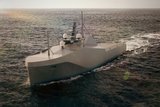
USCGC Calhoun has now entered service with the USCG. (Photo: HII)
Legend-class ships have formed the basis of the National Security Cutter (NSC) programme which has been running since the early 2000s with the intention of replacing ships in service since the 1960s.


HII’s Ingalls Shipbuilding delivered the national security cutter USCGC Calhoun (WMSL 759) to the US Coast Guard (USCG) on 13 October.
Ingalls has now delivered 10 Legend-class ships to the USCG including Calhoun. Fabrication of the final ship, USCGC Friedman (NSC 11), began in May 2021 and handover of the ship will be expected in 2024 or 2025.
Since the turn of the century, Ingalls Shipbuilding has designed and built the USCG’s Legend-class national security cutters.
Related Articles
Hensoldt wins order to provide more TRS-3D multi-mode naval radars to US Coast Guard
HII awarded contract to build UUVs for US Navy Lionfish programme
Bourgainville LHA launched but future of US Navy amphibious ship procurement remains uncertain
The ships have been designed to be capable of embarking on and supporting a wide range of the USCG, the US Navy and NATO missions, with a particular focus on drug interdiction, illegal fishing, disaster relief and defence-support operations.
The first ship-in-class USCGC Bertholf (WMSL-750) was laid down on 29 March 2005 and launched on 29 September 2006. It was commissioned into service on 4 August 2008.
Shephard Defence Insight noted that Calhoun was built by HII under a US$468.7 million fixed-price-incentive contract and Friedman was developed under a $462.13 million contract. All 11 NSCs were procured through to FY2018 and no 12th vessel has been planned.


More from Naval Warfare
-
![Kongsberg Maritime and Thales UK team on Arctic Hunter Type 92 proposal]()
Kongsberg Maritime and Thales UK team on Arctic Hunter Type 92 proposal
The Norwegian company says a commercial hull, proven sonar and a British yard could deliver uncrewed submarine hunters by the end of the decade, but the Royal Navy has not yet set a requirement or timeline.
-
![US Navy weighs “Super Intelligence” role in designing a quieter SSN(X) attack submarine]()
US Navy weighs “Super Intelligence” role in designing a quieter SSN(X) attack submarine
NAVSEA is exploring AI-assisted design for a larger, stealthier submarine with increased weapons capacity and uncrewed-system integration, with lead-boat procurement envisaged from 2040.
-
![Navies need cheaper ways to defeat drones, but can they sustain merchant protection?]()
Navies need cheaper ways to defeat drones, but can they sustain merchant protection?
New interceptors and launchers could help navies preserve missile stocks during prolonged escort operations. Yet lower engagement costs will only improve merchant protection if the weapons are available where ships need defending.