Hensoldt wins order to provide more TRS-3D multi-mode naval radars to US Coast Guard
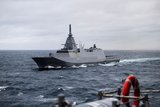
Hensoldt's TRS-3D naval radar equips USCG National Security Cutters. (Photo: USCG)
Hensoldt will deliver another TRS-3D Baseline D multi-mode naval radar to be installed on a USC Legend-class national security cutter (NSC) under a $10 million contract which is in addition to the 12 already delivered for the ships.


The TRS-3D Baseline D, with the US designation AN/SPS-75, utilises gallium nitride and solid-state emitter technology to deliver the same performance while improving reliability and options for future development.
Hensoldt’s TRS-3D radars have been aboard every NSC since the programme’s inception. TRS-3D is a three-dimensional, multi-mode naval radar for air and surface surveillance, target acquisition, self-defence, gunfire support and aircraft control. It automatically detects and tracks all types of air and sea targets, alleviating crew workload requirements.
The TRS-3D/AN/SPS-75 radar is a modular, countermeasure-resistant, medium-range air and surface surveillance system designed for automatic detection, track initiation and tracking of all types of air and sea targets
Related Articles
Latest NSC gets TRS-3D Baseline D radar
With the latest signal processing technologies, it is suited for detection of low-altitude and fast-moving objects and asymmetric threats under severe environmental conditions.
As well as the USCG, the system is also in service with the defence forces of Denmark, Finland, Germany, Malaysia, Norway and Spain as well as aboard some USN Freedom-class Littoral Combat Ships.
Related Equipment in Defence Insight



More from Naval Warfare
-
![Australian industry programme builds pipeline for Virginia-class sustainment]()
Australian industry programme builds pipeline for Virginia-class sustainment
Australian businesses can now bid to support Virginia-class submarine sustainment in Western Australia, as momentum around the Henderson Defence Precinct also builds.
-
![South Korea, Japan and Turkey vie for US shipbuilding access in future frigate contest]()
South Korea, Japan and Turkey vie for US shipbuilding access in future frigate contest
Washington’s search for a foreign-built frigate could hand South Korea, Japan and Turkey a larger prize than a double-hull order: a foothold inside the US shipbuilding industrial base.
-
![German Navy’s Israeli missile test points to deepening defence-industrial ties]()
German Navy’s Israeli missile test points to deepening defence-industrial ties
The test-firing of an Israel Aerospace Industries LORA ballistic missile from a German vessel highlights the Bundeswehr’s focus on speed to capability as it trials Israel’s operationally proven technology.