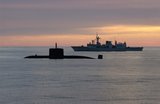
OSI to upgrade navigation systems for legacy German ships
The German Navy F123 frigate Brandenburg. (Photo: US DoD)
OSI is already contracted to supply systems for Germany’s F126 frigates and K130 corvettes.


Through a contract signed by ARCHE and German defence procurement agency BAAINBw, OSI Maritime Systems will supply navigation solutions to upgrade legacy ships and shore establishments.
The RadEA 2 programme covers over 40 platforms, including tankers, Brandenburg-class F123 frigates, and other vessels. Upgrades will begin in Q1 2023 and are due for completion in 2028.
The RadEA award follows recent contracts for integrating OSI’s Integrated Navigation & Tactical System (INTS) into F126 frigates and K130 corvettes.
ARCHE will use OSI’s Electronic Chart Precise Integrated Navigation System (ECPINS) 7 to power the navigation system and, as prime contractor, the company will be responsible for integration, testing and delivery.
The German Navy began modernising navigation systems under RadEA in 2006.
On 2 December, Poland’s PGZ Stocznia Wojenna (PGZ SW) shipyard awarded OSI a contract to provide its INTS for vessels four to six of the Polish Navy Kormoran programme.



More from Naval Warfare
-
![Euronaval 2026: Red Cat’s Blue Ops follows USV demand from Asia to the Andes]()
Euronaval 2026: Red Cat’s Blue Ops follows USV demand from Asia to the Andes
With its B-26 USV in full-rate production, Blue Ops is seeking to turn overseas interest into orders through a combination of lower operating costs, UAV integration and local manufacturing.
-
![Euronaval 2026: ‘I want to sell 31 Type 31s by 2031’ - CGO maps Babcock’s global push]()
Euronaval 2026: ‘I want to sell 31 Type 31s by 2031’ - CGO maps Babcock’s global push
Chief growth officer Sir Nick Hine tells Shephard how Babcock is lining up New Zealand, Chile, Denmark and the US for its Arrowhead 140 frigate, speaks on the hybrid navy offer and talks AUKUS.
-
![Euronaval 2026: Baltic breakthrough powers Saildrone’s next European expansion]()
Euronaval 2026: Baltic breakthrough powers Saildrone’s next European expansion
Denmark’s doubled deployment, Mediterranean smuggling routes and Norwegian composite hulls show where uncrewed surveillance demand is heading, while British funding remains unclear.
-
![Euronaval 2026: by the power of six, Fincantieri’s MMMV reflects modular naval shift]()
Euronaval 2026: by the power of six, Fincantieri’s MMMV reflects modular naval shift
The 50m, six-person ship from the Italian shipbuilder carries swappable, containerised payloads instead of a fixed mission, reflecting a shift that is becoming increasingly evident.