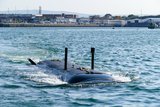
NSC Munro completes acceptance trials


US Coast Guard’s National Security Cutter (NSC) Munro has successfully completed acceptance trials, Huntington Ingalls Industries’ (HII) Ingalls Shipbuilding division announced on 7 October.
The US Navy’s Board of Inspection and Survey team was on board while the HII team put the vessel through her paces in two days of trials in the Gulf of Mexico. The trials included extensive testing of the propulsion system, combat systems, small boat operations, anchor-handling, and electrical and damage control systems.
HII has already made the delivery of five NSCs and has three further vessels under construction. Munro is scheduled be to delivered before the end of 2016; Kimball will follow in 2018, and Midgett is scheduled for a 2019 delivery.
The Legend class of NSCs are designed for maritime homeland security, law enforcement and national security missions. The vessels are 418ft long, 54ft wide and displace 4,500 tons on full load. They can sail at up to 28 knots for a range of 12,000 miles, with a 60-day endurance.

You may also like

More from Naval Warfare
-
![Quantum sensing gathers pace as navies eye undersea advantage]()
Quantum sensing gathers pace as navies eye undersea advantage
As AI dominates defence conversations, industry increasingly points to quantum sensing as the technology set to change submarine and uncrewed underwater vehicle operations.
-
![Competitive P17B tender marks a shift in Indian Navy frigate procurement]()
Competitive P17B tender marks a shift in Indian Navy frigate procurement
The Indian Navy's P17B programme is expected to combine greater weapons capacity with a competitive domestic construction model, although key systems could remain dependent on international supply chains.
-
![How France’s SNLE 3G programme is reshaping the naval nuclear industrial base]()
How France’s SNLE 3G programme is reshaping the naval nuclear industrial base
Extending far beyond a four-submarine replacement programme, France’s ballistic missile submarine effort is a decades-long industrial initiative designed to preserve the country’s ability to build and sustain nuclear-powered strategic platforms.
-
![China’s mineral processing dominance exposes naval supply chain vulnerabilities]()
China’s mineral processing dominance exposes naval supply chain vulnerabilities
Competition for critical minerals, and China’s dominance of their processing, is emerging as a decisive factor in future naval procurement programmes.