Northrop Grumman’s Manta Ray completes testing
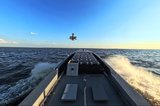
The Northrop Grumman Manta Ray being towed out for trials. (Photo: Northrop Grumman)
Northrop Grumman Systems Corporation was selected in 2021 to build and test and Manta Ray unmanned underwater vehicle (UUVs). A second platform has been under development by PacMar Technologies.


Northrop Grumman has completed full-scale, in-water testing of its Manta Ray UUV which will be developed for the US DoD’s Defense Advanced Research Projects Agency (DARPA).
Testing took place in February and March off the coast of southern California during which it demonstrated at-sea hydrodynamic performance, including submerged operations, so that the vehicle’s modes of propulsion and steering, buoyancy, propellers and control surfaces could all be evaluated.
The company shipped the Manta Ray prototype in subsections from the build location in Maryland as part of an effort to demonstrate transportability and capability to be deployed worldwide with limited support.
The programme will aim to develop and demonstrate a new class of long-duration, long-range, payload-capable UUVs for persistent operations in dynamic maritime environments. DARPA and the US Navy have been working on designing the next steps for testing and transition of the technology.
Dr Kyle Woerner, programme manager for Manta Ray at DARPA, said: “Our successful, full-scale Manta Ray testing validates the vehicle’s readiness to advance toward real-world operations after being rapidly assembled in the field from modular subsections.
“Once deployed, the vehicle uses buoyancy-driven gliding to move through the water,” Woerner continued. “The craft is designed with several payload bays of multiple sizes and types to enable a wide variety of naval mission sets.”
Related Equipment in Defence Insight

More from Naval Warfare
-
![Australian industry programme builds pipeline for Virginia-class sustainment]()
Australian industry programme builds pipeline for Virginia-class sustainment
Australian businesses can now bid to support Virginia-class submarine sustainment in Western Australia, as momentum around the Henderson Defence Precinct also builds.
-
![South Korea, Japan and Turkey vie for US shipbuilding access in future frigate contest]()
South Korea, Japan and Turkey vie for US shipbuilding access in future frigate contest
Washington’s search for a foreign-built frigate could hand South Korea, Japan and Turkey a larger prize than a double-hull order: a foothold inside the US shipbuilding industrial base.
-
![German Navy’s Israeli missile test points to deepening defence-industrial ties]()
German Navy’s Israeli missile test points to deepening defence-industrial ties
The test-firing of an Israel Aerospace Industries LORA ballistic missile from a German vessel highlights the Bundeswehr’s focus on speed to capability as it trials Israel’s operationally proven technology.