Northrop Grumman unveils Manta Ray UUV
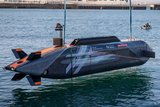
The Manta Ray programme has been developing UUVs which will be expected to be autonomous and able to operate in environments where humans cannot go. (Photo: Northrop Grumman)
The uncrewed underwater vehicle (UUV) prototype was built through a programme by the Defense Advanced Research Project Agency (DARPA) and assembled in Northrop Grumman’s Annapolis facility.


A prototype of a Manta Ray-class vessel, part of a new class of UUVs developed to be energy-saving and able to anchor at the seafloor to rest in a low-power state, has been unveiled by Northrop Grumman.
According to the US defence company, the extra-large glider will be able to carry out tasks for long durations and ranges, as well as be equipped for payload-capable undersea missions.
DARPA stated that the UUV would be built as part of the US government agency’s Manta Ray programme, which has been exploring uncrewed systems that could enable traditional host vessels to operate with more flexibility and freedom.
Related Articles
DARPA taps Lockheed to design new large UUV
DARPA awards contracts for Phase 2 of Manta Ray programme
The project has included at-sea demonstrations and multiple phases while developing UUVs that remain independent of manned vessels and ports.
In 2020, DARPA approached Lockheed Martin to design an extra-large UUV powered by innovative energy management techniques for the Manta Ray project.
In 2021, DARPA awarded Phase 2 agreements to continue the Manta Ray programme to two prime contractors, Northrop Grumman Systems Corporation and Martin Defense Group, renamed PacMar Technologies. Each company was tasked with building and testing unique full-scale demonstration systems.
According to DARPA, PacMar conducted an in-water splash test with its prototype in 2023, testing the glider’s sensors, hydrodynamic performance and autonomy behaviour.
Related Equipment in Defence Insight


More from Naval Warfare
-
![Canada assesses security equipment changes for Polar Icebreaker Imnaryuaq]()
Canada assesses security equipment changes for Polar Icebreaker Imnaryuaq
The Canadian Department of National Defence is evaluating communications and reconnaissance changes for CCGS Imnaryuaq’s expanded maritime security role, while retaining its 2032 acceptance target.
-
![US Navy’s MQ-25 Stingray approaches carrier-integration tests]()
US Navy’s MQ-25 Stingray approaches carrier-integration tests
Boeing has outlined its upcoming precision-landing and carrier-airspace trials as MQ-25 manufacturing shifts towards Illinois, with initial Lot 1 deliveries expected in 2029.
-
![From Poland to the Pacific: can Miecznik become a blueprint for other navies?]()
From Poland to the Pacific: can Miecznik become a blueprint for other navies?
Babcock is taking its Polish industrial partnership approach to Denmark and New Zealand as navies seek sovereign shipbuilding skills alongside ships.