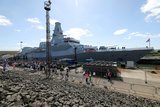
New collision between Greek and Turkish ships in Aegean


Greece on 4 May said one of its warships had collided with a Turkish ship in the Aegean Sea, the latest in a series of terse encounters between the regional rivals and NATO allies.
The Greek navy said the Turkish merchantman ship had ‘approached and touched’ one of its gunboats, which was taking part in a NATO exercise.
After the collision the merchantman fled back towards Turkish waters, the navy said.
‘Nobody was hurt and no serious damage was caused,’ it added.
Turkey has for decades disputed Greek sovereignty over Aegean waters and airspace close to Turkish shores, which Athens says is based on postwar treaties.
The two countries nearly went to war over a cluster of uninhabited islets in 1996, and mock dogfights between the two airforces are common.
In April, a Greek fighter pilot died when his plane crashed in the Aegean while returning from a mission to intercept Turkish jets.
A few days earlier, Greek soldiers had fired warning shots at a Turkish helicopter after it approached the small island of Ro, which is on Greece's border in the Aegean's southeast.
There is also tension over Greece's refusal to extradite eight Turkish soldiers who sought refuge in the country after the failed 2016 army coup against Turkish President Recep Tayyip Erdogan.
The Greek Supreme Court has ruled against extradition, arguing that they would not receive a fair trial in Turkey.
In turn, Turkey has refused to release two Greek soldiers who were caught in March after crossing the border, claiming to have lost their way in the fog.

More from Naval Warfare
-
![RTX Raytheon enhances SM-3 and SM-6 production capacity]()
RTX Raytheon enhances SM-3 and SM-6 production capacity
The expansion of the Redstone facility in Alabama will enable Raytheon to increase production of Standard Missiles in the location by 50% and support Washington in refilling stockpiles after recent operations have depleted the Pentagon’s reserves.
-
![Kraken’s Royal Navy USV contract signals next step in crewed-uncrewed integration]()
Kraken’s Royal Navy USV contract signals next step in crewed-uncrewed integration
The UK Royal Navy’s rapid procurement of uncrewed platforms aligns with the force’s strategic shift towards a fleet better equipped to handle modern threats.
-
![HMS Anson’s milestone stay in Australia cut short during AUKUS deployment]()
HMS Anson’s milestone stay in Australia cut short during AUKUS deployment
The Astute-class submarine’s visit to Australia was the first time maintenance activity on a UK Royal Navy nuclear submarine had been carried out in the country.
-
![How Operation Epic Fury could reduce US readiness to face China]()
How Operation Epic Fury could reduce US readiness to face China
The offensive against Iran could impact training and maintenance cycles and accelerate the degradation of the US arsenal on top of depleting Washington’s stockpiles.
-
![UK Royal Navy explores modular counter-drone capabilities for future hybrid fleet]()
UK Royal Navy explores modular counter-drone capabilities for future hybrid fleet
The UK MoD is scoping out systems to counter the growing threat of uncrewed aerial systems, with a focus on low-cost modularity and speed to field.