Industry creates robotic team comprising UAS and USV
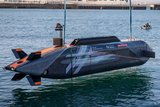
WAM-V with small UAS. (Photo: Marine Advanced Robotics)
Solution from Californian companies blends unmanned naval and aerial capabilities


Marine Advanced Robotics and Planck Aerosystems claim to have created the first ‘multi-domain robotic team’ combining UAS and USV technologies.
Marine Advanced Robotics and Planck Aerosystems have established a new strategic alliance that includes an unmanned Wave Adaptive Modular Vessel (WAM-V) equipped with a small unmanned aircraft system (sUAS) that operate together for advanced mission profiles.
Previous cooperation between Planck Aerosystems and Marine Advanced Robotics included collaborative multi-domain deployments for USN base security.
Mark Gundersen, CEO of Marine Advanced Robotics, claimed the new sUAS-USV combination, designed to operate together for advanced mission profiles, ‘will enable greater situational awareness for multiple applications’.
Potential uses include maritime security and naval operations in the open ocean as well as offshore infrastructure inspection, the two companies announced on 9 August.
The sUAS is powered by the Autonomous Control Engine from Planck Aerosystems. It can be operated remotely as a push-button capability, which includes autonomous launch and recovery, as well as automatic securing and recharging while not in flight.
Marine Advanced Robotics claims the USV can travel long distances unsupported, even in high sea states, and can host additional sensors above and below the water.
The combined system is currently in trials for early customers. It will be offered to customers in Q4 2021.




More from Naval Warfare
-
![Autonomy gives Turkey a chance to outflank established naval shipbuilders]()
Autonomy gives Turkey a chance to outflank established naval shipbuilders
Turkish shipbuilders have sold ships from Asia to Europe, but autonomy and swarm technology could give them a fairer fight against Western European rivals.
-
![France’s naval modernisation drives opportunities for European defence industry]()
France’s naval modernisation drives opportunities for European defence industry
Ahead of Euronaval 2026, major submarine, frigate and aircraft carrier programmes are driving investment, while future corvette replacements and growing interest in uncrewed vessels offer further opportunities for industry into the 2030s and beyond.
-
![Canada assesses security equipment changes for Polar Icebreaker Imnaryuaq]()
Canada assesses security equipment changes for Polar Icebreaker Imnaryuaq
The Canadian Department of National Defence is evaluating communications and reconnaissance changes for CCGS Imnaryuaq’s expanded maritime security role, while retaining its 2032 acceptance target.
-
![All eyes on Royal Navy’s Type 93 market engagement as industry prepares bids]()
All eyes on Royal Navy’s Type 93 market engagement as industry prepares bids
Responses are due by 29 October as the Royal Navy tests the market, with BAE Systems’ Herne and MSubs’ Excalibur setting up a contest where payloads may decide the winner.
-
![US Navy’s MQ-25 Stingray approaches carrier-integration tests]()
US Navy’s MQ-25 Stingray approaches carrier-integration tests
Boeing has outlined its upcoming precision-landing and carrier-airspace trials as MQ-25 manufacturing shifts towards Illinois, with initial Lot 1 deliveries expected in 2029.