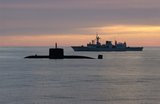
HMS Pembroke participates in NATO exercise


The British Royal Navy’s HMS Pembroke, a Sandown class minehunter, has participated in a NATO exercise, the navy announced on 7 June. The ship worked as a part of Standing Mine Counter Measures Group 1 (SMCMG1).
The task group for Exercise Open Spirit included 14 NATO and partner nations – the US, Sweden, Poland, Norway, the Netherlands, Lithuania, Latvia, Germany, France, Estonia, Denmark, Canada and Belgium.
The mine-hunter operated off the coast of Lithuania and covered 54nm2 of seabed, scanning and identifying around 912 objects. Of these objects, 15 mines and three torpedoes turned out to be explosive ordnance and were tackled by the task group.
Wrecks of three ships, three exercise mines, 34 mine chairs and parts from two rockets were also identified by the scanning.
HMS Pembroke located a Russian mine from the First World War in the approaches of Lithuania's Klaipeda harbour, using its sonar system. It then deployed a remote underwater vehicle for positive identification of the object, after which explosive ordnance disposal divers disposed of the mine.
Lt Cdr Jim Lovell, Commanding Officer of HMS Pembroke, said: ‘For six of Pembroke’s crew this was their first deployment and the opportunity to work as part of NATO in the Baltic region is not something which many on board have experienced before. It was a good result for HMS Pembroke and demonstrates the unique capability that mine hunters provide for the Royal Navy and NATO.’
Related Equipment in Defence Insight



More from Naval Warfare
-
![Hanwha Ocean and TKMS are firming up their Canadian next-gen submarine proposals]()
Hanwha Ocean and TKMS are firming up their Canadian next-gen submarine proposals
CPSP competitors are proposing platforms fitted with advanced, next-generation capabilities to be built and sustained in cooperation with the Canadian industry.
-
![UK’s $1 billion AUKUS support request signals strong ongoing US collaboration]()
UK’s $1 billion AUKUS support request signals strong ongoing US collaboration
The latest foreign military sales request from the UK has implications for the future of the programme and collaboration between the three nations.
-
![What the rise of interoperability between Western allies means for defence procurement]()
What the rise of interoperability between Western allies means for defence procurement
Major naval initiatives including the European Patrol Corvette programmes and Norway’s UK partnership-focused purchase of Type 26 frigates point to the growing interest in the advantages of commonality across allied navies.