HII demonstrates autonomy integration with Sea Machines’ SM300
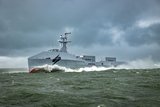
HII integrated its advanced autonomy solutions with Sea Machines’ SM300 product on a HII test platform. (Photo: HII)
Advanced autonomy solutions from HII and Sea Machines support mission planning and collaboration between uncrewed systems.


The Technical Solutions Division of Huntington Ingalls Industries (HII) on 5 January announced it had successfully integrated its advanced autonomy solutions with Sea Machines Robotics’ SM300 autonomy product.
The company said the two autonomous capabilities support mission planning and collaboration between uncrewed systems.
During a demonstration in late 2021, HII’s collaborative autonomy and mission planning behaviours were overlayed with the Sea Machines SM300 system on a USV.
HII Technical Solutions’ Unmanned Systems business group president Duane Fotheringham said the demonstrated marked an important milestone in the company’s autonomy development.
Fotheringham added: ‘The integration was seamless and illustrates the immense potential for our open architecture autonomy to work collaboratively with other autonomous systems.’
Sea Machine’s SM300 can be fitted on vessels to enable remotely commanded USV operations.
HII’s autonomy managed mission delegation during the demonstration and allowed collaborative autonomy with other uncrewed systems while providing the SM300 with the information needed to manage the USVs heading and speed.
In 2020, HII announced the acquisition of a minority share in Sea Machines as part of its push into the uncrewed systems space.
Related Equipment in Defence Insight


More from Naval Warfare
-
![Competitive P17B tender marks a shift in Indian Navy frigate procurement]()
Competitive P17B tender marks a shift in Indian Navy frigate procurement
The Indian Navy's P17B programme is expected to combine greater weapons capacity with a competitive domestic construction model, although key systems could remain dependent on international supply chains.
-
![How France’s SNLE 3G programme is reshaping the naval nuclear industrial base]()
How France’s SNLE 3G programme is reshaping the naval nuclear industrial base
Extending far beyond a four-submarine replacement programme, France’s ballistic missile submarine effort is a decades-long industrial initiative designed to preserve the country’s ability to build and sustain nuclear-powered strategic platforms.
-
![China’s mineral processing dominance exposes naval supply chain vulnerabilities]()
China’s mineral processing dominance exposes naval supply chain vulnerabilities
Competition for critical minerals, and China’s dominance of their processing, is emerging as a decisive factor in future naval procurement programmes.
-
![Suppliers await next step in Australia’s mine warfare transition]()
Suppliers await next step in Australia’s mine warfare transition
Australia’s mine countermeasure capability remains in flux as the Huon-class nears retirement, but accelerated investment in autonomous systems is opening a path for industry.
-
![Can the US Navy ask Indo-Pacific allies to do more while training with them less?]()
Can the US Navy ask Indo-Pacific allies to do more while training with them less?
As the Iran War draws US ships and marine corps units away from the Indo-Pacific, curtailed exercises and a temporary carrier gap are exposing tensions between Washington’s demand for more self-reliant allies and the joint training needed to realise that ambition.