Sea Machines to develop autonomous supply platforms
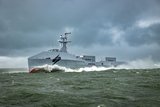
Rendering of an autonomous replenishment platform. (Photo: Sea Machines.)
The Department of Defense (DoD) contract aims to produce autonomous full-scale ocean-going vertical take-off landing replenishment platforms.


The US DoD’s Defense Innovation Unit (DIU) has awarded Sea Machines a $3million contract to develop an autonomous full-scale ocean-going replenishment platform.
The contract builds on earlier work by Sea Machines at the behest of the DoD to engineer, build and demonstrate system kits capable of transforming commercial barges into platforms that can land and replenish military aircraft.
That work is now transitioning from proof of concept to a design and trial stage.
Sea Machines founder and CEO Michael Johnson said: ‘The extension of our contract represents the intersection of traditional sectors, such as government, and the capabilities of autonomous technology.’
The prototype kit will include the company’s SM300 autonomous command and control system.
The end goal of this project is the successful deployment of the autonomous control kit on multiple barges, increasing the DoD’s ‘agility’ in deploying and replenishing assets globally.
Johnson added: ‘This program is a perfect example of autonomous technology opening up new operational capabilities and leveraging new technology for operational advantages.’
Sea Machines is working with FOSS Maritime for the project, with the latter responsible for developing the naval architecture.
FOSS Maritime is also providing operations management for the outfitting of a remotely commanded deck barge able to land helicopters and house a ‘scaled fuelling station’ for aircraft, surface vessels and shore replenishment.


More from Naval Warfare
-
![Israeli Navy looks to expand as war reshapes future force requirements]()
Israeli Navy looks to expand as war reshapes future force requirements
Israel’s navy is preparing for a larger and more technically diverse role, but its ambitions could be impacted by supply chain restrictions, accelerating demand for domestic naval production as well as autonomous maritime capabilities.
-
![Competitive P17B tender marks a shift in Indian Navy frigate procurement]()
Competitive P17B tender marks a shift in Indian Navy frigate procurement
The Indian Navy's P17B programme is expected to combine greater weapons capacity with a competitive domestic construction model, although key systems could remain dependent on international supply chains.
-
![How France’s SNLE 3G programme is reshaping the naval nuclear industrial base]()
How France’s SNLE 3G programme is reshaping the naval nuclear industrial base
Extending far beyond a four-submarine replacement programme, France’s ballistic missile submarine effort is a decades-long industrial initiative designed to preserve the country’s ability to build and sustain nuclear-powered strategic platforms.
-
![Quantum Systems enters maritime domain with Baltic-focused USV and UUV]()
Quantum Systems enters maritime domain with Baltic-focused USV and UUV
Quantum Systems has launched into the maritime domain with Seavex and Subvex, aiming to close a Baltic Sea ISR gap opened by infrastructure sabotage.