Germany fires shipboard laser weapon for the first time
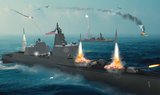
High-energy laser weapons for navies are especially useful for defending against drones, swarms and small boats at close ranges. (Photo: MBDA)
Navies across the globe are looking to lasers to help defend their ships from aerial threats, and Germany is no exception.


On 30 August, the German F124 frigate Sachsen engaged drones at short and very short ranges with a laser weapon in a first for the German Armed Forces.
The weapon used in the test was developed by the country’s High-Energy Laser Naval Demonstrator working committee, AGRE, comprising MBDA Deutschland and Rheinmetall Waffe Munition.
Integration and testing of the laser weapon demonstrator began in late 2021. The system was then later installed on board the Sachsen in Kiel.
The trial verified the capability of sensors, including an EO suite and radar. Operational testing included multiple highly realistic engagement scenarios.
Germany will continue to test the high-energy laser weapon into mid-2023. The results of this further testing will help determine the pathway to a fully-functional operational laser weapon.

More from Naval Warfare
-
![FNSS looks to put uncrewed vehicles at the front of amphibious assaults]()
FNSS looks to put uncrewed vehicles at the front of amphibious assaults
The new platform is designed to put reconnaissance, obstacle clearance and fire support ahead of the crewed force in a contested landing.
-
![US Navy’s $275 billion BBGN plan hinges on shipyard transformation]()
US Navy’s $275 billion BBGN plan hinges on shipyard transformation
The US Navy’s planned nuclear-powered warship carries a US$275 billion price tag, but the greater story lies in the industrial overhaul needed to build it, from AI-enabled design to digital twins and modular construction.
-
![Industry sees opportunity in Australia’s shift to networked undersea warfare]()
Industry sees opportunity in Australia’s shift to networked undersea warfare
Australia’s new defence innovation strategy indicates a shift from platform-centric to network-centric undersea warfare, with Ocius and Anduril Industries pointing to fast-growing opportunities for local industry.
-
![Asia-Pacific emerges as the largest export market for US-made USVs]()
Asia-Pacific emerges as the largest export market for US-made USVs
Asian customers have placed one of the largest known international purchases of US-built uncrewed surface vessels, highlighting accelerating regional demand for autonomous maritime capabilities and distributed naval operations.