German naval laser weapon development takes shape
A demonstrator system featuring laser capabilities is to be tested under realistic conditions on a German Navy frigate in 2022.


German defence procurement agency BAAINBw has awarded the ARGE consortium, comprising MBDA Deutschland and Rheinmetall Waffe Munition, a contract to build, integrate and support testing of a naval laser weapon demonstrator.
‘The order value is in the low double-digit million euro range,’ Rheinmetall announced on 28 January. ‘Work will be shared out on a roughly equal basis.’
The demonstrator is to be made, tested and integrated by the end of the 2021. Trials aboard the German Navy frigate Sachsen are planned for 2022.
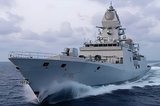
Both companies announced in 2019 that they were collaborating to develop a laser demonstrator for Braunschweig-class corvettes (pictured).
For the new project, MBDA Deutschland will be responsible for the operator console as well as tracking and linking the laser weapon demonstrator to the C2 system.
Rheinmetall is in charge of the laser weapon station, the beam guiding system, cooling, and integration of the laser weapon system into the project container of the laser source demonstrator.
‘The contract is an important step on the path to an operational high-energy laser system,’ said Doris Laarmann, head of laser business development at MBDA Deutschland. ‘Once it’s installed, the demonstrator will also be used to test important aspects such as the interaction and function of the sensor suite, combat management system and effector as well as rules of engagement.’
Alexander Graf, head of the laser weapons programme at Rheinmetall Waffe Munition, and Dr Markus Jung, head of laser development at the company, said the latest project ‘marks a systematic extension of the functional prototype laser weapon successfully tested in recent years’.
As part of our promise to deliver comprehensive coverage to our Defence Insight and Premium News subscribers, our curated defence news content provides the latest industry updates, contract awards and programme milestones.

You may also like


More from Naval Warfare
-
![From the Baltic to the Gulf: where USV procurement is heading next]()
From the Baltic to the Gulf: where USV procurement is heading next
Saildrone’s new Copenhagen base is one sign of a larger shift, as navies globally turn to uncrewed vessels for surveillance and mine clearance.
-
![Israeli Navy looks to expand as war reshapes future force requirements]()
Israeli Navy looks to expand as war reshapes future force requirements
Israel’s navy is preparing for a larger and more technically diverse role, but its ambitions could be impacted by supply chain restrictions, accelerating demand for domestic naval production as well as autonomous maritime capabilities.
-
![Quantum sensing gathers pace as navies eye undersea advantage]()
Quantum sensing gathers pace as navies eye undersea advantage
As AI dominates defence conversations, industry increasingly points to quantum sensing as the technology set to change submarine and uncrewed underwater vehicle operations.
-
![Competitive P17B tender marks a shift in Indian Navy frigate procurement]()
Competitive P17B tender marks a shift in Indian Navy frigate procurement
The Indian Navy's P17B programme is expected to combine greater weapons capacity with a competitive domestic construction model, although key systems could remain dependent on international supply chains.
-
![How France’s SNLE 3G programme is reshaping the naval nuclear industrial base]()
How France’s SNLE 3G programme is reshaping the naval nuclear industrial base
Extending far beyond a four-submarine replacement programme, France’s ballistic missile submarine effort is a decades-long industrial initiative designed to preserve the country’s ability to build and sustain nuclear-powered strategic platforms.
-
![Quantum Systems enters maritime domain with Baltic-focused USV and UUV]()
Quantum Systems enters maritime domain with Baltic-focused USV and UUV
Quantum Systems has launched into the maritime domain with Seavex and Subvex, aiming to close a Baltic Sea ISR gap opened by infrastructure sabotage.