France challenges Beijing in South China Sea


France is increasing its military presence in the Indo-Pacific region, sending warships through the South China Sea and planning air exercises to help counter China’s military build-up in disputed waters.
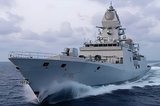
In late May 2018, the French assault ship Dixmude and a frigate sailed through the disputed Spratly Islands and around a group of reefs that China has turned into islets to push back against Beijing’s claim to own most of the resource-rich South China Sea.
Jean Porcher, the Dixmude’s commanding officer, told reporters in a video interview: ‘Our patrol involved passing close to these islets to obtain intelligence with all the sensors it is possible to use in international waters.’
Writing in The Wall Street Journal, a researcher from the Hudson Institute think tank who was onboard, said that ‘several Chinese frigates and corvettes’ tailed the French vessels.
Porcher said the ship maintained ‘cordial’ radio contact with Chinese military vessels, ‘which were present in the area until we left.’
So far the US has taken the lead in confronting China over its territorial claims in the South China Sea, which are contested by several neighbours, particularly Vietnam.
But France, which along with Britain is the only European nation to regularly send its navy into the region, has also waded into the dispute, sending its ships into the South China Sea three to five times a year.
In August 2017, the French Air Force will stage its biggest-ever exercises in southeast Asia as part of a strategy to mark France’s presence in a region that is home to 1.5 million French citizens in the country’s overseas territories.
Three Rafale fighter jets, one A400M troop transporter and a C135 refuelling tanker will fly from Australia to India, with several stop-offs along the way.
The sea and air operations follow a visit by President Emmanuel Macron in May 2018 to Australia, where he spoke of the need to protect the Indo-Pacific region from ‘hegemony’ – a veiled reference to Beijing’s growing might.
He stressed that France, which will be the last country in the EU after Britain leaves the bloc to have territories in the Pacific, did not want to antagonise China.
But a ‘strong Indo-Pacific axis’ was needed to ensure respect for freedom of navigation and aviation in the region, he told Australian Prime Minister Malcolm Turnbull.
Macron appears to be ‘realistically assessing the growing Chinese challenge’, said Jonas Parello-Plesner, a researcher from the US-based Hudson Institute who was an observer on the recent French navy voyage.
Parello-Plesner wrote in The Wall Street Journal: ‘This is a welcome change from his predecessors, who were enthralled by the business and investment opportunities in China.’
But France had already begun to push back against China’s expansionism before Macron took power.
Since 2014, the navy has sailed regularly through the South China Sea as part of its stated bid to uphold a rules-based maritime order.
In 2016, then French Defence Minister Jean-Yves Le Drian (now the Foreign Minister) called on other European navies to develop a regular and visible presence in the South China Sea.
Besides protecting navigation, France has cited the need to defend the interests of its citizens scattered across five French territories in the Pacific, including New Caledonia and French Polynesia.
Current Defence Minister Florence Parly said during a visit to Singapore in early June 2018: ‘This region is also our home.’
Valerie Niquet, an expert on the Asia-Pacific region at the Foundation for Strategic Research in Paris, said France’s growing assertiveness showed the US was no longer the only Western power ‘getting involved in the area.’
Predicting that it would marginalise China’s position a little bit more, Niquet said: ‘Faced with China the US obviously plays the main deterrent role, but it’s not pointless or trivial for a power like France, a permanent member of the (UN) Security Council, to take a firm, principled position and carry out concrete actions.’
Analysts point to another factor underpinning France’s growing activism in the Indo-Pacific region: the need to show buyers of French arms that Paris has their back.
In 2016, India agreed buy 36 Rafale fighter jets and Australia signed a deal worth AUD$50 billion ($37 billion) for 12 next-generation French submarines.
Niquet said: ‘That is also doubtlessly pushing France to be a lot firmer on subjects that, up until recently, were broached with great care.’

You may also like

More from Naval Warfare
-
![Competitive P17B tender marks a shift in Indian Navy frigate procurement]()
Competitive P17B tender marks a shift in Indian Navy frigate procurement
The Indian Navy's P17B programme is expected to combine greater weapons capacity with a competitive domestic construction model, although key systems could remain dependent on international supply chains.
-
![How France’s SNLE 3G programme is reshaping the naval nuclear industrial base]()
How France’s SNLE 3G programme is reshaping the naval nuclear industrial base
Extending far beyond a four-submarine replacement programme, France’s ballistic missile submarine effort is a decades-long industrial initiative designed to preserve the country’s ability to build and sustain nuclear-powered strategic platforms.
-
![China’s mineral processing dominance exposes naval supply chain vulnerabilities]()
China’s mineral processing dominance exposes naval supply chain vulnerabilities
Competition for critical minerals, and China’s dominance of their processing, is emerging as a decisive factor in future naval procurement programmes.
-
![Suppliers await next step in Australia’s mine warfare transition]()
Suppliers await next step in Australia’s mine warfare transition
Australia’s mine countermeasure capability remains in flux as the Huon-class nears retirement, but accelerated investment in autonomous systems is opening a path for industry.
-
![Can the US Navy ask Indo-Pacific allies to do more while training with them less?]()
Can the US Navy ask Indo-Pacific allies to do more while training with them less?
As the Iran War draws US ships and marine corps units away from the Indo-Pacific, curtailed exercises and a temporary carrier gap are exposing tensions between Washington’s demand for more self-reliant allies and the joint training needed to realise that ambition.