Open menu Search

Eurosatory 2026: Schiebel’s frigate-first strategy indicates a shift in UAV competition

19th June 2026 - 10:59 GMT | by Harry McNeil in Paris, France

RSS

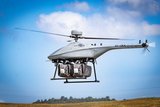
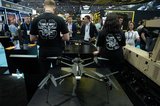
Schiebel’s Camcopter S-301 rotary-wing UAV on display at Eurosatory 2026, with South Korea among its international customers. (Photo: author)

Schiebel is pursuing opportunities in the UK and France while leveraging its integration with Naval Group’s FDI frigate programme to create new naval business across Europe.

Schiebel’s pursuit of UK and French defence programmes, coupled with its growing relationship with Naval Group, highlighted how uncrewed aviation companies are increasingly positioning themselves alongside naval shipbuilders to secure long-term growth opportunities.

Speaking to Shephard at Eurosatory 2026, Schiebel outlined ambitions spanning the UK Ministry of Defence’s (MoD) Project Nyx programme, a new French Army requirement and further naval expansion linked to the success of the Camcopter S-100 aboard Naval Group’s Frégate de Défense et d’Intervention (FDI) frigates.

The strategy reflects a wider trend: securing integration onto a warship platform can create follow-on opportunities each time that vessel is exported.

DSEI 2025: Schiebel reveals two weaponised Camcopter UAVs

Sweden swayed by speed to capability in French frigate win

The FDI frigate: a growing success story with more opportunities to come

UK and French programmes offer opportunities

Alongside continued international sales of its Camcopter S-100, Schiebel is attempting to establish its larger S-300 rotary-wing uncrewed air system in several emerging competitions.

The company confirmed it had been selected for the next phase of the British Army’s Project Nyx programme alongside partner Thales.

Project Nyx is part of the British Army’s Land Autonomous Collaborative Platform (LACP) programme, which aims to develop a highly autonomous, sovereign system to be paired with crewed Apache AH-64E systems, Shephard Defence Insight highlights.

“Now in the UK you’ve got a thing called Project Nyx,” Neil Hunter, global head of sales, told Shephard. “It’s a British Army loyal wingman concept. So we teamed with Thales, so we’re now chasing Project Nyx in the UK.”

According to the UK MoD, Project Nyx aims to develop drones capable of accompanying British Army helicopters on missions including reconnaissance, surveillance, strike, target acquisition and electronic warfare, operating on a “command rather than control” basis using increasing levels of autonomy.

Shephard forecasts that a procurement programme worth US$205 million could be awarded in 2028, following the development of the system through Project Nyx.

France has emerged as another target market. Schiebel is pursuing the French Army’s ADAPT requirement, which could be argued as a successor to the cancelled Patroller programme.

The company is again partnering with Thales. “We’re obviously trying to create leverage in that area,” Hunter said. “Why not look at a rotary? Teaming with Thales, more the French side, because of course to win contracts here in France, you have to be as French as you possibly can.”

The opportunities are notable because they would provide early reference customers for the S-300, which is currently undergoing an extensive test and evaluation campaign ahead of deliveries to South Korea.

“We’re on track to deliver three aircraft by the end of the year,” Hunter said. “There’s an awful lot of overlap between the S-100 and the S-300, which gives us lots of maturity and confidence.”

The company also disclosed it was pursuing a further S-300 opportunity with an unnamed NATO customer.

“There’s one NATO country, and we’re sort of going, let’s get you over the line,” Hunter noted.

FDI frigates create a naval pathway

While the S-300 offers future growth potential, the S-100 remains Schiebel’s principal revenue generator.

One of the most significant recent successes came in Greece, where the Hellenic Navy selected the Camcopter S-100 for operation from its FDI frigates. The contract represented Schiebel’s 50th customer for the S-100 programme.

“The Greek Navy was our 50th customer in 20 years,” Hunter said. “The initial contract with them is to deliver four systems.”

Schiebel’s Camcopter UAV is positioned to operate from Naval Group’s FDI frigates. (Photo: Schiebel)

Schiebel previously revealed that the Hellenic Navy’s FDI frigates were pre-fitted for Camcopter S-100 integration.

The company worked directly with Naval Group during ship construction to optimise the placement of antennas and mission-system components.

“For the Greek Navy FDIs, we actually worked with Naval Group while they were building those ships in the first place,” Hunter explained. “We had discussions with them about where it was best placed to put the antennas.”

The arrangement demonstrates the benefits of engaging shipbuilders early in the design process.

“Working with a shipbuilder at those early stages, we’re able to make sure all the cabling and different components are in the right place,” Neil added.

That integration work could now generate further opportunities. Athens has moved ahead with a fourth FDI frigate, potentially creating demand for an additional Camcopter system.

“My understanding is they’ve now contracted to buy the fourth FDI from Naval Group,” Hunter said. “Hopefully we will start talking to them soon about giving them a fifth system to go on the fourth FDI.”

Schiebel also sees opportunities beyond the FDI fleet. “There are other classes of ships. Why not put S-100s on those?” Hunter added.

Can Naval Group’s relationship create further wins?

The wider significance of the Greek programme may lie in what happens next.

Naval Group has secured FDI orders from France and Greece and recently achieved another export breakthrough with Sweden’s selection of the platform.

Although Schiebel faces competition in Sweden from domestic supplier UMS Skeldar, the company acknowledged it is actively promoting the S-100 as a lower-risk and more mature solution.

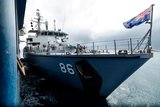
Sweden has recently selected the FDI Frigate from Naval Group for its Luleå programme. (Photo: Naval Group)

“As you would expect, we are lobbying into Sweden,” Hunter said. “We’re giving the Swedes all the reasons why we’re a much less risky solution, a mature solution.”

The outcome remains uncertain, but Sweden illustrates how naval exports can create secondary opportunities for suppliers already integrated onto a platform.

For Schiebel, the lesson appears clear: the more warship classes carrying Camcopter systems, the greater the potential addressable market when those vessels are sold abroad.

That thinking is influencing the company’s wider naval strategy. “I think our methodology is to basically try and have a relationship with every shipbuilder and shipyard out there,” Hunter claimed. “We have to have relationships with shipbuilders.”

The company monitors international ship sales and pursues both shipbuilders and end users simultaneously.

“We try and keep an eye on where ships are being sold to which countries,” the executive explained. “We have to do a two-pronged attack – one into the end customer, but also to the shipbuilder.”

Estonia was cited as one example, with shipbuilding teams exploring potential Camcopter integration options as future naval procurement plans develop.

As naval primes continue exporting frigates and other surface combatants across Europe and beyond, Schiebel appears intent on ensuring Camcopter is considered part of the package.

UAS: communication systems | Land Autonomous Collaborative Platform (LACP) (Project NYX) [UK]

Tactical Drone System (SDT) (15-28) [France]

Optional Fourth FDI Frigate [Greece]

Camcopter S-300

Camcopter S-100

AH-64E Apache Guardian

Harry McNeil

Author

Harry McNeil


Harry McNeil is Shephard's Naval Reporter. Before joining, he spent almost two years as an …

Read full bio

Share to

Linkedin