Croatian Navy fires RBS15


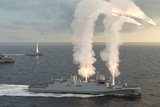
The Croatian Navy has fired the Saab RBS15 anti-ship missile from the Kralj-class missile boat Dmitar Zvonimir, marking the force’s first firing of the missile from a vessel.
The firing took place during Exercise Joint Force 15, held which was held in the ugen Kvaternik military training area, Slunj, and on the naval ranges at Dugi otok at the start of October.
The Croatian Navy previously fired the missile from a land-based launcher in May.
The RBS15 is designed for naval engagements from short distances to ranges well beyond the horizon. The surface-launched missile can be integrated on ships, land batteries and mobile launchers. It is also in service as an air-launched weapon that is integrated on the Gripen fighter and compatible with other NATO aircraft.
Gen Drago Lovric, Chief of General Staff of the Croatian Army, said: ‘The RBS15 missile is the primary armament of our missile gunboats and the firing of this missile indicates the purpose of the existence and the ability of these gunboats. Furthermore, we showed that the Croatian Navy is ready to defend every part of the territorial sea and target any enemy ship that jeopardises our national territory.’
Stefan Öberg, head of missile systems, Saab, said: ‘The target was completely destroyed by the missile in a testament to the maintainability and reliability of the RBS15, and the Croatian customer’s expertise and technical know-how.
‘We are very impressed by the exemplary manner in which the current system has been maintained and operated by the Croatian Navy. This level of expertise will surely mean that these missiles will remain in service with the Croatian Navy well into the future. We look forward to further collaboration with the Croatian MoD, on all fronts.

You may also like

More from Naval Warfare
-
![Can the US Navy ask Indo-Pacific allies to do more while training with them less?]()
Can the US Navy ask Indo-Pacific allies to do more while training with them less?
As the Iran War draws US ships and marine corps units away from the Indo-Pacific, curtailed exercises and a temporary carrier gap are exposing tensions between Washington’s demand for more self-reliant allies and the joint training needed to realise that ambition.
-
![How could Rheinmetall’s GMF 140 fit with ongoing programmes in North America?]()
How could Rheinmetall’s GMF 140 fit with ongoing programmes in North America?
With Canada committed to its River-class replacement and the USN pursuing a lower-cost frigate, Rheinmetall will need to demonstrate where the GMF 140 can fill a capability gap in the North American fleet.
-
![Australian industry programme builds pipeline for Virginia-class sustainment]()
Australian industry programme builds pipeline for Virginia-class sustainment
Australian businesses can now bid to support Virginia-class submarine sustainment in Western Australia, as momentum around the Henderson Defence Precinct also builds.
-
![South Korea, Japan and Turkey vie for US shipbuilding access in future frigate contest]()
South Korea, Japan and Turkey vie for US shipbuilding access in future frigate contest
Washington’s search for a foreign-built frigate could hand South Korea, Japan and Turkey a larger prize than a double-hull order: a foothold inside the US shipbuilding industrial base.
-
![Russia’s uncrewed boat portfolio hints at future naval demand]()
Russia’s uncrewed boat portfolio hints at future naval demand
Ukrainian intelligence has catalogued more than 20 Russian uncrewed surface vessels, revealing a portfolio weighted towards mine warfare and logistics, with implications for Western naval investment.