AUKUS – Sweet in the mouth, bitter in the belly (Opinion)
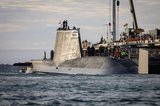
Could Australia lease a couple of US Navy Los Angeles-class SSNs as a way of getting its feet wet with nuclear-powered submarines? (USN)
Australia is looking at decades before receiving its first nuclear-powered submarines. But surely there are faster options available?


‘And I took the little book out of the angel’s hand, and ate it up; and it was in my mouth sweet as honey: and as soon as I had eaten it, my belly was bitter.’ (Revelation 10:10)
Saint John might have been talking about the recent AUKUS (Australia, United Kingdom, United States) agreement. With AUKUS, the US and UK have agreed to share nuclear submarine technology with the Aussies and for all three to cooperate on a range of other technologies: AI, cyber, quantum, undersea, missile etc.
But the big thing is the promise to provide Australia with
Our news & analysis is now part of Defence Insight®
A Basic-level or higher Defence Insight subscription is now required to view this content.



More from Naval Warfare
-
![Five years on: where could opportunities emerge next for AUKUS Pillar II?]()
Five years on: where could opportunities emerge next for AUKUS Pillar II?
Payload commonality, combat systems and electronic warfare are emerging as likely priorities as the trilateral partnership balances building submarines with sharing industrial ecosystems.
-
![Singapore expands maritime presence with future-ready Sentinel OPV]()
Singapore expands maritime presence with future-ready Sentinel OPV
Singapore is building space for uncrewed systems and future technologies into its new Sentinel-class OPVs, reflecting a wider move towards adaptable vessels capable of maintaining persistent maritime presence.
-
![From the Baltic to the Gulf: where USV procurement is heading next]()
From the Baltic to the Gulf: where USV procurement is heading next
Saildrone’s new Copenhagen base is one sign of a larger shift, as navies globally turn to uncrewed vessels for surveillance and mine clearance.
-
![Quantum sensing gathers pace as navies eye undersea advantage]()
Quantum sensing gathers pace as navies eye undersea advantage
As AI dominates defence conversations, industry increasingly points to quantum sensing as the technology set to change submarine and uncrewed underwater vehicle operations.
-
![Competitive P17B tender marks a shift in Indian Navy frigate procurement]()
Competitive P17B tender marks a shift in Indian Navy frigate procurement
The Indian Navy's P17B programme is expected to combine greater weapons capacity with a competitive domestic construction model, although key systems could remain dependent on international supply chains.