ATK Awarded $97M Contract to Develop the Multi-Stage Supersonic Target for the US Navy
Alliant Techsystems announced today that it has been awarded a $97 million contract for the design, development, integration, and test of the Multi-Stage Supersonic Target (MSST) by the Naval Air Systems Command, Patuxent River, Maryland. With incentives, the value of the contract announced today could reach $103 million. The system design and development phase of the program is expected to be complete by October 2012. Once this phase of the program concludes, the company believes there could be follow-on production awards that generate significant business for ATK over the next decade.
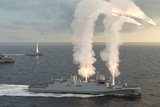
The MSST will simulate a two-stage anti-ship cruise missile threat. It consists of a two-stage unmanned aerial target, a launcher, and associated support equipment. The U.S. Navy will use MSST to evaluate the operational effectiveness of weapons/combat systems against next-generation surface-to-surface anti-ship missiles that cruise at subsonic speeds, initiate a separation event, and then make a supersonic dash to the intended target.
Under terms of the contract, ATK and its teammate, CEi of Sacramento, Calif., will build two engineering evaluation units and seven engineering development models. MSST is the foundation for ATK’s targets and anti-ship missile strategy and is the result of an innovative design team and world class systems engineering tools deployed in ATK’s virtual engineering network. The MSST will provide threat representation for the developmental and operational testing of major weapon systems. Work will be performed in Sacramento, Calif., Woodland Hills, Calif., Plymouth, Minn., Elkton, Md., and Wichita, Kan.
ATK is a premier aerospace and defense company with more than 17,000 employees in 21 states and approximately $4.6 billion in revenue. News and information can be found on the Internet at http://www.atk.com.




More from Naval Warfare
-
![Suppliers await next step in Australia’s mine warfare transition]()
Suppliers await next step in Australia’s mine warfare transition
Australia’s mine countermeasure capability remains in flux as the Huon-class nears retirement, but accelerated investment in autonomous systems is opening a path for industry.
-
![Can the US Navy ask Indo-Pacific allies to do more while training with them less?]()
Can the US Navy ask Indo-Pacific allies to do more while training with them less?
As the Iran War draws US ships and marine corps units away from the Indo-Pacific, curtailed exercises and a temporary carrier gap are exposing tensions between Washington’s demand for more self-reliant allies and the joint training needed to realise that ambition.
-
![How could Rheinmetall’s GMF 140 fit with ongoing programmes in North America?]()
How could Rheinmetall’s GMF 140 fit with ongoing programmes in North America?
With Canada committed to its River-class replacement and the USN pursuing a lower-cost frigate, Rheinmetall will need to demonstrate where the GMF 140 can fill a capability gap in the North American fleet.
-
![Australian industry programme builds pipeline for Virginia-class sustainment]()
Australian industry programme builds pipeline for Virginia-class sustainment
Australian businesses can now bid to support Virginia-class submarine sustainment in Western Australia, as momentum around the Henderson Defence Precinct also builds.
-
![South Korea, Japan and Turkey vie for US shipbuilding access in future frigate contest]()
South Korea, Japan and Turkey vie for US shipbuilding access in future frigate contest
Washington’s search for a foreign-built frigate could hand South Korea, Japan and Turkey a larger prize than a double-hull order: a foothold inside the US shipbuilding industrial base.
-
![Japan’s FY2027 budget bets on stand-off systems to offset demographic decline]()
Japan’s FY2027 budget bets on stand-off systems to offset demographic decline
Japan’s FY2027 defence budget backs stand-off strike, a 17-aircraft MQ-9B buy and a declared bid to lead the world in uncrewed maritime assets, alongside new frigates, submarines and support ships.