Will reliance on Russian supply chain scupper Lazar APC upgrades?
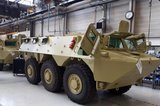
The Lazar 3 8x8 fitted with a remote weapon station armed with two 30mm cannon laid onto the target by a day/night sighting system. (Photo: Christopher Foss)
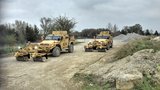
Two Serbian armoured vehicles, the Lazar 8x8 and the Lazanski 8x8, have been equipped with different remote controlled weapon stations and protection levels.


The Lazar 8x8 was originally introduced into service with Serbian forces fitted with a roof-mounted unstabilised remote controlled weapon station armed with a 12.7mm machine gun.
For trial purposes, the Lazar 3 has now been integrated with a remote-controlled weapon station (RCWS) armed with two 30x210mm single-feed cannon each provided with 110 rounds of ready ammunition, with a claimed maximum range in the ground-to-ground role of 2,000m.
A prototype Lazar 3M has also been completed, which is equipped with a Russian RCWS armed with a stabilised 30mm dual-feed cannon and 7.62mm coaxial machine gun (MG) laid onto the target via
Our news & analysis is now part of Defence Insight®
A Basic-level or higher Defence Insight subscription is now required to view this content.


More from Land Warfare
-
![AUSA 2026: companies adapt munitions and missiles for greater effect at lower costs]()
AUSA 2026: companies adapt munitions and missiles for greater effect at lower costs
Rather than developing entirely new weapons, defence companies are looking to build on existing weapons and systems to deliver greater capability, control costs and accelerate fielding.
-
![With changing patterns in Middle Eastern procurement, is Europe missing out?]()
With changing patterns in Middle Eastern procurement, is Europe missing out?
Traditional suppliers are struggling to meet the Middle East’s armoured vehicle modernisation needs, creating opportunities for South Korean manufacturers and regional defence industries.
-
![AUSA 2026: CUAS market expands as suppliers target new threats and operational requirements]()
AUSA 2026: CUAS market expands as suppliers target new threats and operational requirements
New developments from MARSS, MyDefence, Mountain Horse Solutions and Rafael suggest that future counter-drone protection will increasingly depend on combining advanced detection, rapid interception and integrated defensive networks.