US Marine Corps selects Silvus radios for ground vehicle comms
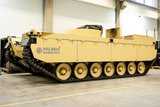
USMC ACV crews will use Silvus StreamCaster radios for on-the-move communications as part of the NOTM system. (Photo: USMC)
Silvus Technologies will supply radios for on-the-move communications on board USMC armoured vehicles under a $5 million dollar contract.


Silvus Technologies announced on 6 December that Marine Corps Systems Command (MCSC) has selected StreamCaster 4400 MANET (mobile area network) radios for use in the Networking On-the-Move (NOTM) communications system uused in the marine corps' Joint Light Tactical Vehicles (JLTVs) and Amphibious Combat Vehicles (ACVs).
According to a company release, StreamCaster radios were selected due to their ability to create a self-organising mesh network across multiple spectrum bands at high data rates.
The 4400 MANET will enable Marine Air-Ground Task Forces to access SATCOM, and connect and network dispersed vehicles, air assets and dismounted units. Marines can use NOTM to transmit information to commanders and increase situational awareness in hostile environments.
Related Articles
GDLS bets on innovative capabilities in USMC ARV competition
US Marine Corps tests Northrop Grumman AN/TPS-80 Ground/Air Task Oriented Radar
StreamCaster radios also support the proprietary Mobile Networked MIMO (MN-MIMO) waveform to enable operations in congested and contested spectrum environments.
Related Programmes in Defence Insight
ACV - Additional Order 2 (US - USMC)
ACV - Additional Order 1 (US - USMC)
Related Equipment in Defence Insight

More from Land Warfare
-
![Milrem outlines plans for Havoc and Vector as Ukrainian THeMIS numbers set to double]()
Milrem outlines plans for Havoc and Vector as Ukrainian THeMIS numbers set to double
Milrem’s THeMIS uncrewed ground vehicle is one of the most battle-proven medium UGV platforms in service, with the company looking to have production versions of new large platforms ready before the end of the decade.
-
![US Precision Strike Missile makes combat debut in Operation Epic Fury]()
US Precision Strike Missile makes combat debut in Operation Epic Fury
CENTCOM confirmed that PrSMs have been deployed in the offensive against Iran, bringing what it called “an unrivalled deep strike capability”.
-
![February land forces roundup: ST Engineering and Russia lift the lid on new platforms]()
February land forces roundup: ST Engineering and Russia lift the lid on new platforms
This month we saw a major presence from Turkish, Russian and Chinese companies at the World Defense Show with new vehicles from major suppliers, while elsewhere there were evolving mortar programmes and artillery modernisation efforts.