US Marine Corps orders ACV-30 test vehicles with Kongsberg remote weapons station
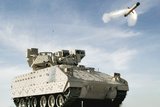
ACV-30 with 30mm Kongsberg RWS. (Photo: DVIDS)
A full-rate production decision from the USMC for the ACV-30 may follow a period of testing.


The USMC has awarded BAE Systems Land & Armaments an $88 million contract modification to build multiple ACV-30 Production Representative Test Vehicles (PRTVs) equipped with the Kongsberg RT-20 30mm remote weapons station.
‘Once delivered, the PRTVs will undergo a period of testing prior to a full-rate production decision,’ BAE Systems stated on 15 August.
The modification brings to $1.91 billion the cumulative face value of the Amphibious Combat Vehicle (ACV) contract for BAE Systems, according to the DoD.
Work will be completed by July 2025 at 14 US locations plus Norway and Italy.
ACV-30 is part of a family of vehicles that also includes personnel (ACV-P), command (ACV-C) and recovery (ACV-R) variants, all of which are being produced by BAE Systems under contract from the USMC.
BAE Systems is also conducting a study for the USMC on how a C4/UAS payload could be integrated with the ACV.
Related Programmes in Defence Insight
Related Equipment in Defence Insight

More from Land Warfare
-
![AUSA 2026: companies adapt munitions and missiles for greater effect at lower costs]()
AUSA 2026: companies adapt munitions and missiles for greater effect at lower costs
Rather than developing entirely new weapons, defence companies are looking to build on existing weapons and systems to deliver greater capability, control costs and accelerate fielding.
-
![AUSA 2026: CUAS market expands as suppliers target new threats and operational requirements]()
AUSA 2026: CUAS market expands as suppliers target new threats and operational requirements
New developments from MARSS, MyDefence, Mountain Horse Solutions and Rafael suggest that future counter-drone protection will increasingly depend on combining advanced detection, rapid interception and integrated defensive networks.
-
![US Army seeks CAML-Lite autonomous launcher prototypes for 2027 live-fire trials]()
US Army seeks CAML-Lite autonomous launcher prototypes for 2027 live-fire trials
The optionally crewed, C-130-transportable platforms would combine modular offensive and defensive fires with autonomous resupply, with demonstrations planned for Talisman Sabre 2027.