US Army orders over 400 Oshkosh tactical vehicles
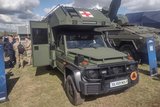
The FMTV A2 received its initial production contract in 2018. (Photo: Oshkosh Defense)
The US Army has now ordered more than 1,400 FMTV A2 vehicles since the original contract award in 2018.


Oshkosh Defense announced on 16 January that US Army Tank-Automotive and Armaments Command (TACOM) Life Cycle Management Command (LCMC) had placed a $141 million order for 414 Family of Medium Tactical Vehicles A2 (FMTV A2) plus 56 FMTV trailers.
The FMTV A2 is a modernised version of the A1P2 model, offering higher protection levels, a larger payload, improved off-road mobility, a more powerful engine and upgraded electrics system. As well as combat missions it is used for logistics operations and disaster relief.
‘Since we were awarded the FMTV A2 production contract in 2018, we’ve worked closely with the US Army to refine the platform and add additional capabilities,’ said Pat Williams, chief programme officer for FMTV at Oshkosh Defense. ‘We’re confident that we are delivering the best performing medium tactical vehicle in the world.’
Related Articles
Oshkosh Defense wins FMTV A2 contract
AUSA 2022: Common Tactical Truck competition attracts AM General-Iveco bid
Rheinmetall demonstrates art of the possible for autonomous trucks
This latest contract take the total number of FMTV A2s ordered to 1,412 plus 800 trailers, with a combined value of $627 million.
Related Equipment in Defence Insight

You may also like

More from Land Warfare
-
![Tulpar firing trials expand Hitfact Mk II platform options]()
Tulpar firing trials expand Hitfact Mk II platform options
Firing trials of the Tulpar and Leonardo Hitfact Mk II combination follow an integration programme covering mechanical, electrical, electronic and software interfaces.
-
![How to breach a minefield: from traditional systems to modern techniques in action]()
How to breach a minefield: from traditional systems to modern techniques in action
The news from Ukraine has again shown that antitank minefields and other obstacles on the battlefield, such as deep trenches, can play a key role in both offensive and defensive operations. Given this, there will always be a need to clear them, both during and after a conflict.
-
![British Army's open plan draws diverse offerings for Land Rover replacement]()
British Army's open plan draws diverse offerings for Land Rover replacement
The UK Ministry of Defence has avoided being prescriptive in its search to replace the British Army’s Land Rover, meaning vehicle types being offered range from Land Rover Defender Wolf II and Humvee to the hybrid series Fering Pioneer. What does this mean for the procurement process?
-
![DVD 2026: British Army’s Ajax back in the hands of users as part of a gradual return]()
DVD 2026: British Army’s Ajax back in the hands of users as part of a gradual return
The introduction of Ajax vehicles into British Army service was stopped after operator health issues were reported during an exercise, but manufacturer General Dynamics Land Systems UK believes work over the past 10 months has dealt with the problems.
-
![Europe commits to long-range fires but countries move in different directions]()
Europe commits to long-range fires but countries move in different directions
Sweden, Croatia and France are pursuing different rocket artillery solutions as European armies seek greater reach, survivability and industrial resilience.