


US Army orders Mantis i23 gimbaled sensor payloads


The US Army has ordered Mantis i23 gimbaled sensor payloads from AeroVironment for its fleet of RQ-11B Raven unmanned aircraft systems (UAS). The contract, worth $20 million, was announced on 2 October.
AeroVironment was awarded the contract following a competitive bid process, and will supply the payloads within 12 months.
The Mantis i23 payload will enhance the capabilities of the of the army’s RQ-11B Raven fleet. Each multi-axis pan, tilt and zoom sensor payload includes a daylight digital camera and infrared thermal imaging camera that are packaged to provide reliable operation in harsh environments, delivering uninterrupted video imagery.
Roy Minson, senior vice president and general manager, AeroVironment’s UAS business segment, said: ‘Since delivering the first Raven system to the army nearly ten years ago, we have remained relentlessly focused on ensuring that our customers have the most capable, reliable and effective tactical UAS available.
‘The army’s Raven system, with AeroVironment’s rugged gimbaled sensor payload and the recent digital data link upgrade of its entire fleet, is a modern tool for gaining superiority on the battlefield.’
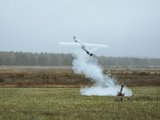
The RQ-11B Raven unmanned aircraft system is a 4.5-pound, backpackable, hand-launched sensor platform that provides day and night, real-time video imagery wirelessly to a portable ground control station for ‘over the hill’ and ‘around the corner’ reconnaissance, surveillance and target acquisition in support of tactical units.
Related Equipment in Defence Insight



More from Land Warfare
-
![Can NATO’s CUAS marketplace turn urgent demand into deliveries?]()
Can NATO’s CUAS marketplace turn urgent demand into deliveries?
Framework contracts and leasing options aim to shorten acquisition timelines, while manufacturing partnerships could help suppliers scale production to meet allied demand.
-
![A medium UGV market emerges as the US weighs up its options]()
A medium UGV market emerges as the US weighs up its options
The US is pursuing multiple UGV programmes, from commercial robotic platforms to new autonomy technologies. The combination of these efforts could prove key to turning ambition into operational capability.
-
![NATO looks for answers to overcome standards hurdles and improve procurement]()
NATO looks for answers to overcome standards hurdles and improve procurement
NATO is looking to artificial intelligence to provide integration between different C2 systems to create a common operational picture, potentially offering a faster route to interoperability than the slow-moving processes of NATO standards committees.
-
![NATO FUSE exercise plays out real-world scenario in the face of eastern border risks]()
NATO FUSE exercise plays out real-world scenario in the face of eastern border risks
The large-scale exercise in Latvia was the culmination of three experimentation initiatives to see how platforms, weapons and systems could fit into the alliance’s Eastern Flank Deterrence Initiative. As well as forces, it brought together companies and equipment.
-
![Canada accelerates uncrewed aerial system procurement for NATO and Arctic forces]()
Canada accelerates uncrewed aerial system procurement for NATO and Arctic forces
Canada plans to acquire at least 120 uncrewed aerial systems through two competitions with combined funding ceilings of C$32 million.
-
![October land forces roundup: AUSA dominates as list narrows for new British Army vehicle]()
October land forces roundup: AUSA dominates as list narrows for new British Army vehicle
New counter-drone technologies, autonomous launchers and manufacturing modernisation initiatives highlighted emerging opportunities for defence suppliers, while the UK advanced a major military vehicle procurement programme.







