US Army awards General Dynamics $112m for Stryker combat vehicle work
General Dynamics Land Systems has been awarded three contracts by the US Army to support performance specification changes to and fielding of the Stryker vehicle. The contracts are worth a combined $112.2 million. General Dynamics Land Systems is a wholly owned subsidiary of General Dynamics.
“The Stryker is called ‘the backbone’ of the Army’s medium armored brigades and with these contracts, we will continue to strengthen the vehicle so it can protect our troops in theatre,” said Mike Cannon, senior vice president of General Dynamics Land Systems’ Ground Combat Systems. “Stryker delivers strength, speed, lethality and survivability where it counts.”
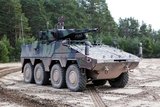
Stryker brigades have logged an estimated 25 million miles during 13 rotations to war zones. The Stryker is an eight-wheeled combat vehicle that is lighter, smaller and more readily deployable than other Army combat vehicles. Proven effective by the Army and the National Guard for defense and disaster-response missions, the Stryker family of vehicles stresses performance and commonality to reduce the logistics footprint and minimize costs. Strykers are available in ten variants: infantry carrier vehicle; commander’s vehicle; medical evacuation vehicle; fire support vehicle; engineer squad vehicle; anti-tank guided missile; mortar carrier; reconnaissance vehicle; mobile gun system; and nuclear, biological and chemical reconnaissance vehicle.
Under one contract for $92 million from the US Army TACOM Life Cycle Management Command, General Dynamics will provide design and integration engineering services, prototypes, procurement of materials and components and an integrated solution that will deliver improved blast-protection levels to support Stryker brigades.
The second contract, worth $11.7 million, is to acquire the production cut-in for alternators and air conditioning for Stryker Mobile Gun System (MGS) vehicles. The MGS variant is a direct-fire infantry assault platform with a 105mm tank cannon mounted in a low-profile, fully stabilized, “shoot-on-the-move” turret to support dismounted infantry. It destroys vehicles, equipment and hardened positions with its bunker- and wall-breaching capability. It is also equipped to detect nuclear, biological and chemical weapons. Work on the contract is expected to by February 2011.
The third contract awarded is valued at $8.5 million and funds equipment and components in support of total package fielding of Stryker vehicles. Work on the contract is expected be completed by September 2011.
Work on these contracts will be performed in Sterling Heights, Mich. and London, Ontario, Canada by existing General Dynamics employees.
Source: General Dynamics





More from Land Warfare
-
![Northrop Grumman pushing ahead with smaller Integrated Battle Command System]()
Northrop Grumman pushing ahead with smaller Integrated Battle Command System
Northrop Grumman’s Integrated Battle Command System is in service with Polish forces and is being introduced to US forces, with further development underway on the original platform as well as a smaller, more mobile system.
-
![UK’s ground-based air defence effort remains in assessment phase after third industry day]()
UK’s ground-based air defence effort remains in assessment phase after third industry day
The UK’s plan to introduce a new air defence capability into the British Army will cover short and medium-range defence as well as counter-uncrewed aerial system systems. Timelines are not yet laid out but industry is making plans.
-
![K9 Thunder gains momentum across three key international markets]()
K9 Thunder gains momentum across three key international markets
Recent activity across Australia, Norway and the US highlights Hanwha Defense’s expanding presence in a self-propelled artillery market reshaped by the demands of modern warfare.
-
![Dominating the spectrum: ASELSAN’s EW capabilities take center stage at MSPO 2026]()
Dominating the spectrum: ASELSAN’s EW capabilities take center stage at MSPO 2026
ASELSAN is showcasing its advanced electronic warfare (EW) capabilities at MSPO 2026, highlighting technologies designed to detect, analyse, disrupt and deceive threats across increasingly contested electromagnetic environments.
-
![US Army set to receive first ISV-U-mounted Scorpion Light mortar]()
US Army set to receive first ISV-U-mounted Scorpion Light mortar
Global Military Products will begin deliveries next week under a US$12.9 million agreement covering digitally enabled 81mm mortar systems, vehicle integration and army fire-control technology.