Russian ground platform losses approach 10,000, Ukrainian MoD claims
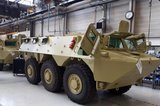
Russian combat vehicle that was attacked by Ukrainian forces. (Photo: Ukrainian MoD)
The Ukrainian MoD released a list of Russian military systems destroyed to date. It includes 1,742 MBTs, 3,979 combat vehicles, 894 artillery systems, 258 multiple launch rocket systems and 2,854 land vehicles and fuel tankers.


The Ukrainian MoD announced on 28 July that Russia has lost 9,727 ground vehicles since the conflict started in February. The service published a list of military equipment that were destroyed by the Ukrainian armed forces (see list below).
It includes 1,742 MBTs, 3,979 combat vehicles, 894 artillery systems, 258 multiple launch rocket systems and 2,854 land vehicles and fuel tankers.
Although the figures are disputed by Russia and open-source intelligence analysts such as Oryx describe a much lower total based on visually verified losses, several pictures and footage of Russian vehicles being attacked or exploding have been published on
Our news & analysis is now part of Defence Insight®
A Basic-level or higher Defence Insight subscription is now required to view this content.


More from Land Warfare
-
![AUSA 2026: companies adapt munitions and missiles for greater effect at lower costs]()
AUSA 2026: companies adapt munitions and missiles for greater effect at lower costs
Rather than developing entirely new weapons, defence companies are looking to build on existing weapons and systems to deliver greater capability, control costs and accelerate fielding.
-
![AUSA 2026: CUAS market expands as suppliers target new threats and operational requirements]()
AUSA 2026: CUAS market expands as suppliers target new threats and operational requirements
New developments from MARSS, MyDefence, Mountain Horse Solutions and Rafael suggest that future counter-drone protection will increasingly depend on combining advanced detection, rapid interception and integrated defensive networks.
-
![US Army seeks CAML-Lite autonomous launcher prototypes for 2027 live-fire trials]()
US Army seeks CAML-Lite autonomous launcher prototypes for 2027 live-fire trials
The optionally crewed, C-130-transportable platforms would combine modular offensive and defensive fires with autonomous resupply, with demonstrations planned for Talisman Sabre 2027.