Supacat and NP Aerospace deliver lightweight recovery vehicles to British Army
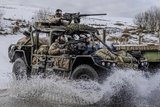
A Supacat LWRV recovering an HMT vehicle. (Photo: Supacat/NP Aerospace)
Supacat and NP Aerospace have this week delivered lightweight recovery vehicles to the British Army as part of the PMETS contract, addressing the off-road recovery needs of high mobility transport vehicles.


Supacat and NP Aerospace have delivered the first two of four Lightweight Recovery Vehicles (LWRVs) to British Army units as part of the UK MoD Protected Mobility Engineering and Technical Support (PMETS) contract.
The LWRV, designed by Supacat and NP Aerospace as engineering authority for the contract, has successfully reached IOC. The vehicles were presented to the Vehicle Support Team within the MoD’s Defence Equipment & Support organisation at an event at Supacat facilities in Devon, England.
In June 2023, serving members from the Royal Scots Dragoon Guards and Royal Irish Regiment received operational training on the vehicles, and this week received their first vehicles. Later this year, the army will receive two further Supacat LWRV vehicles to fulfil a need for off-road capability in harsh environments like those encountered during Operation Newcombe in Mali.
LWRV is designed to fill the capability gap for a recovery vehicle with the off-road performance to follow the routes of the British Army’s High Mobility Transport Jackal and Coyote vehicles, developed by Supacat.
The solution utilises four in-service Jackal 2 vehicles with the addition of Supacat’s Extenda removable third axle to provide the recovery module and configure the 4x4 Jackal 2 as the 6x6 Coyote. The LWRV solution incorporates Supacat’s Supalift recovery system, enabling the recovery of both the Foxhound and HMT platforms.
Related Equipment in Defence Insight


More from Land Warfare
-
![More bidders move onto starting grid for British Army Land Rover replacement programme]()
More bidders move onto starting grid for British Army Land Rover replacement programme
The Light Mobility Vehicle segment of the UK’s Land Mobility Programme for the British Army may actually be about to make progress, or at least likely bidders seem to think so. Shephard spoke with several contenders who revealed their views on how the army should replace the ageing fleet.
-
![Northrop Grumman pushing ahead with smaller Integrated Battle Command System]()
Northrop Grumman pushing ahead with smaller Integrated Battle Command System
Northrop Grumman’s Integrated Battle Command System is in service with Polish forces and is being introduced to US forces, with further development underway on the original platform as well as a smaller, more mobile system.
-
![UK’s ground-based air defence effort remains in assessment phase after third industry day]()
UK’s ground-based air defence effort remains in assessment phase after third industry day
The UK’s plan to introduce a new air defence capability into the British Army will cover short and medium-range defence as well as counter-uncrewed aerial system systems. Timelines are not yet laid out but industry is making plans.
-
![K9 Thunder gains momentum across three key international markets]()
K9 Thunder gains momentum across three key international markets
Recent activity across Australia, Norway and the US highlights Hanwha Defense’s expanding presence in a self-propelled artillery market reshaped by the demands of modern warfare.