Why modern air defense demands layers: inside Türkiye’s Steel Dome revolution
From swarming drones to hypersonic missiles, single-layer defenses are no longer
enough. Türkiye’s Steel Dome shows the way forward.


Enjoy free access to this sponsored article, all content provided by ASELSAN.
Historically, air defense was focused on intercepting a single missile or aircraft. But the nature of modern threats has changed, and changed fast. Today’s adversaries don’t attack with one bullet; they attack with a storm. Swarms of low-flying drones evade radar, cruise missiles skim the landscape, and ballistic projectiles descend from hundreds of kilometers away, often all at once. No single radar, weapon, or jammer can handle all these threats on its own.
This is why the concept of multi-layered air defense is no longer optional. It’s essential.
Modern militaries now rely on integrated architectures where each system plays a specific role: detect early, track accurately, respond quickly, and neutralize effectively. From electronic warfare and sensor fusion to interceptors and jammers, the entire ecosystem must act in unison. When done right, this kind of system creates an invisible shield over a nation’s territory. And few countries have demonstrated this as clearly or as ambitiously as Türkiye.
Steel Dome: Türkiye’s national shield
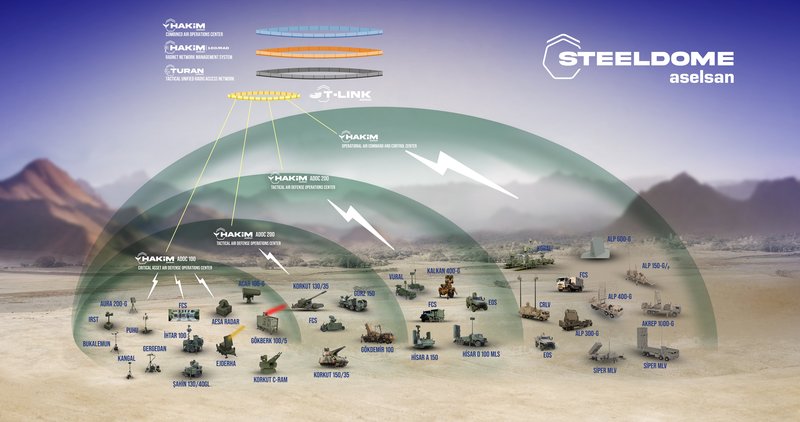
Steel Dome is Türkiye’s answer to the complexity of 21st-century air threats. It’s not a single platform, nor just a radar or missile. It’s a fully integrated, AI-supported ecosystem built by Türkiye’s leading defense electronics company, ASELSAN, in partnership with ROKETSAN and TÜBİTAK SAGE. This architecture combines sensors, effectors, command and control systems, and electronic warfare capabilities into a national air and missile defense grid that is both intelligent and expandable.
At the heart of the system is HAKİM, ASELSAN’s AI-powered command and control platform. It collects data from across the sensor network — long-range radars, electro-optical systems, passive detection assets — and turns it into real-time decision support. HAKİM allows the system to automatically assess threats, assign targets, and coordinate responses across multiple weapon systems. The result is a faster, smarter, and more survivable defense posture.
What does this mean in practice?
Imagine a hostile actor launching a drone swarm to saturate an early warning network, followed by cruise missiles targeting key infrastructure. In traditional defense setups, this could overwhelm radar coverage or lead to delayed engagement decisions. With Steel Dome, that same scenario triggers automated responses at multiple levels: electronic warfare systems like KORAL 200 jam the drones’ communication links, passive radars sense stealthy cruise signatures, and effectors like SİPER or HİSAR are launched in seconds — all coordinated through a unified battle network.
This level of orchestration ensures that threats are countered not only effectively but also with minimal delay.
And it’s not just theoretical.
Scalable architecture, proven deployment
Türkiye is actively building out its Steel Dome architecture. In 2025 alone, 47 key components, worth $460 million, were delivered to the Turkish Armed Forces by ASELSAN, including SİPER, HİSAR, KORKUT, ALP, and PUHU systems. These represent every layer of the architecture: early warning, precision engagement, close-range protection, and electronic support. ASELSAN’s recent investments of over $1.5 billion are further accelerating the production pipeline, creating hundreds of new jobs and rapidly expanding Türkiye’s defense industry capacity, marking the establishment of the largest integrated air defense facility in Europe, which will serve as the production hub for Steel Dome units.
But perhaps the most powerful aspect of Steel Dome is its modularity and future-readiness.
Built to evolve with new threats
The system is built on open architecture. This means new technologies can be integrated without redesigning the entire setup. Need better drone defense? Add EJDERHA, a high-powered electromagnetic anti-UAV system. Want secure tactical links? Deploy T-LINK solutions to connect command centers, effectors, and forward-deployed units. As threats evolve, so does the dome.
Steel Dome’s architecture also resists electronic and cyber-attacks, thanks to centralized frequency management and military-grade cyber-security protocols. In a world where battles are increasingly fought in the invisible spectrum, this resilience matters as much as missile range.
A model for sovereign air defense
Beyond Türkiye, Steel Dome is a case study for nations seeking sovereign, scalable air defense solutions. Its success shows that it is possible to build a national shield without overdependence on foreign platforms. It’s also a clear example of what happens when sensor integration, AI, and layered response philosophy are implemented from the ground up — not bolted on afterward.
As defense planners around the world consider how to counter fast-changing aerial threats, Türkiye’s Steel Dome stands as a bold and timely blueprint. It doesn’t just intercept missiles. It rewrites the rules of air defense for an era defined by speed, complexity, and electronic warfare.
Because in the skies of tomorrow, the best defense is not just reaction. It’s intelligent coordination.



More from Industry Spotlights
-
![Orchestrating operational readiness across every defence domain]()
Orchestrating operational readiness across every defence domain
Are all systems ready for the next mission? Have upgrades been applied? Are all assets aligned to deploy together, on time and fully prepared? In modern defence operations, readiness is no longer measured platform by platform. It is measured by how well people, assets, data and decisions move together — across land, sea and air.
-
![Extending mission readiness: where XR adds real value in pilot, crew and maintenance training]()
Extending mission readiness: where XR adds real value in pilot, crew and maintenance training
Extended reality (XR) is becoming increasingly relevant in military aviation training, adding a flexible layer to an integrated ecosystem spanning the pilot, crew, and maintenance domains.
-
![Dominating the spectrum: ASELSAN’s EW capabilities take center stage at MSPO 2026]()
Dominating the spectrum: ASELSAN’s EW capabilities take center stage at MSPO 2026
ASELSAN is showcasing its advanced electronic warfare (EW) capabilities at MSPO 2026, highlighting technologies designed to detect, analyse, disrupt and deceive threats across increasingly contested electromagnetic environments.
-
![“Creating a decision advantage”: how C-UAS is evolving to reduce the operator burden]()
“Creating a decision advantage”: how C-UAS is evolving to reduce the operator burden
In Conversation… Speaking to Shephard’s Gerrard Cowan, Dr Brian Shand, Director – Advanced Concepts & Technology at L3Harris, explains how, as operators face growing numbers of low-cost drones, C-UAS providers must focus on reducing operator workload, transforming fragmented sensor data into effective decision-making.
-
![Shield the warfighter, win the fight (video)]()
Shield the warfighter, win the fight (video)
BAE Systems’ Intrepid Shield™ approach delivers full-spectrum electromagnetic protection to detect, exploit, and counter advanced threats.
-
![How joint ventures are expanding Rheinmetall's munitions portfolio (video)]()
How joint ventures are expanding Rheinmetall's munitions portfolio (video)
Roman Köhne, CEO of Rheinmetall's Weapon and Ammunition Division, discusses the company's announcements at Eurosatory 2026, including developments in defence technology, precision systems, industrial partnerships and future capability programmes.