Rheinmetall’s Lynx XM30 to go to “shakedown testing” ahead of its delivery to the US Army
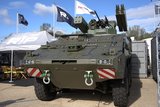
American Rheinmetall Lynx XM30. (Photo: American Rheinmetall)
American Rheinmetall is currently carrying out construction and integration of its Lynx prototypes selected for Phase 4 of the US Army XM30 Mechanised Infantry Combat Vehicle (MICV) programme (previously named Optionally Manned Fighting Vehicle [OMFV]). Set to be handed over to the branch in Q3 2026, the platforms will first pass through an in-house assessment.
“Before delivery to the army, American Rheinmetall will conduct internal shakedown testing on the prototypes,” an official spokesperson for the company told Shephard.
Under this process, the company will evaluate whether systems and subsystems are operating safely, reliably and within required performance parameters. The focus will be on subsystem integration, powerpack performance, initial mobility runs and digital system validation.
Related Articles
Axe swings on US Army procurements
US Army modernisation plans raise big concerns for lawmakers
Next-generation gun set to boost US Army combat vehicle capabilities
“The goal is to ensure the prototypes arrive ready for the army’s comprehensive test campaign,” the official explained, adding that “build activities are proceeding in alignment” with the XM30 programme schedule, and the vehicles will be sent to the branch “this year as planned”.
Rheinmetall already incorporated improvements and modifications to its design based on the US Army’s evaluations and soldier feedback from past phases of the XM30 initiative.
The company’s spokesperson noted that the supplier has refined “key aspects” of the vehicle around the lethality package, survivability architecture, mobility systems and digital backbone “at every stage” of the programme.
“This collaborative, feedback-driven approach [used by the army in the effort] is central to how we engineer and integrate advanced combat systems,” the official claimed.
Alongside General Dynamics Land Systems (GDLS) prototypes, Rheinmetall’s Lynx XM30 will undergo testing within the US Army as part of the fourth phase of this effort. The 1st Cavalry Division at Fort Hood, Texas, will be the first unit to receive prototypes this autumn, according to the US Congressional Research Service (CRS).
In a report published in April, the Congressional Research Service (CRS) stated that the Army Test and Evaluation Command (ATEC) will “work in conjunction with the division to monitor the assessments” from soldiers, who will provide feedback to engineers for “minor adjustments”.
Meanwhile, in its FY2027 budget request, the branch stated that “award decisions will be based on contractor performance” during Production Qualification Testing (PQT) and Initial Operational Test and Evaluation (IOT&E).
“In Phase 4, we expect the US government to rigorously test and evaluate the Lynx XM30 in a full range of operationally relevant conditions,” Rheinmetall’s official pointed out. “We are looking forward to seeing the vehicle put through its paces in mobility trials, lethality and gunnery events, and integrated unit exercises.”
XM30 competitors: a two-horse race
In June 2023, the US Army awarded US$1.6 billion in firm-fixed-price contracts to GDLS and American Rheinmetall Vehicles for the detailed design and prototype build and testing phases of the XM30. Under those deals, each supplier should deliver up to 11 prototype vehicles, two ballistic hulls and turrets, armour coupons and digital engineering data.
GDLS is competing with its Wolf XM30, a vehicle described as affordable, efficient and purpose-built for the US Army’s requirements. It can mount a 50mm cannon and carry up to eight dismounted soldiers.

The platform is planned to provide cyber security and artificial intelligence (AI) capabilities, safe autonomy and advanced threat protection.
Shephard contacted GDLS, but it could not provide comments before this publication on its XM30 proposal and ongoing building activities.
Rheinmetall’s Lynx, in turn, accommodates a crew of two, a 50mm LANCE 5030 remote turret with an XM913 50mm cannon controlled via a fully digital fire control system. A flexible vehicle control architecture enables the operation of all vehicle systems from multiple locations.
Other features include two electro-optical sights, each equipped with a high-resolution camera, Raytheon 3GEN FLIR sight thermal imager and laser range finder.
Its multi-mission launcher has been built to allow the Lynx to fire the Tube-launched Optically tracked Wire-guided (TOW) missile, FGM-148 Javelin and the Coyote Block 3 loitering munitions.
Uncertainties surrounding the XM30 programme
The future of the XM30 has been blurry since May 2025, when the service announced a restructuring of its acquisition efforts aligned with the guidelines of the 2024 Army Transformation Initiative (ATI).
The process involved the termination of programmes described as obsolete, such as the procurement of the M10 Booker light tank.
Other implications were a reduction in the purchase of systems considered ineffective or redundant, including the High-Mobility Multipurpose Wheeled Vehicles (HMMWV), Joint Light Tactical Vehicle (JLTV), Apache AH-64D attack helicopters and Gray Eagle uncrewed aerial vehicles.
At that time, both the Robotic Combat Vehicle (RCV) and XM30 were not mentioned in the branch modification plans. However, later that year, the army decided not to move forward with the RCV, shifting gears towards less expensive autonomous platforms. At that time, the estimated cost per RCV system was $3 million.
Since the XM30 will also be an optionally crewed, expensive platform, doubts about the continuation of the efforts have been raised. Shephard Defence Insight noted that each platform is expected to cost $9.6 million. The army’s decision not to sign documentation finalising the Milestone B decision in February 2026 added additional questions regarding the future of the programme.
The uncertainty was partly dissipated after the US Army released its FY2027 budget proposal. The request included nearly $850 million for the XM30. It consists of $547 million to procure 19 vehicles, hulls and turrets and another $290 million for RDT&E efforts associated with the programme.

In its justification papers, the branch stated that the vehicle will be a “cornerstone” of the Armoured Brigade Combat Team (ABCT) by enhancing lethality, survivability and manoeuvrability in high-intensity combat against near-peer adversaries.
“Its ability to control robotic systems and semi-autonomous platforms adds another layer of capability, allowing the formation to extend its reach and maintain dominance across the battlefield,” the service noted in the documents.
Bradley’s replacement curse
The XM30 will substitute the M2 Bradley Fighting Vehicle, which has been in service for more than four decades. Phasing out the platform, though, has been a headache for the US Army as the branch is currently in its sixth attempt to replace the system.
In the 1980s, it conducted the Armoured Systems Modernisation (AMS) effort to develop a new family of combat platforms. With the end of the Cold War, the initiative was terminated in 1992 due to the reduced threat environment aligned with the programme’s unsustainable costs.
Meanwhile, in 1999, the army announced the Future Combat Systems (FCS), a large-scale effort to procure lighter, modular and deployable vehicles that was cancelled in 2009.
The Ground Combat Vehicle (GCV) was the service’s third try. Carried from 2010 to 2014, it intended to purchase a heavily armoured vehicle capable of carrying a full nine-member infantry squad. The platform’s excessive weight and price, however, led the branch to scrap it.
In 2018, it initiated the Next Generation Combat Vehicle (NGCV) programme to explore a new family of systems, which was turned into the Optionally Manned Fighting Vehicle (OMFV) effort in the same year. This programme was then paused and restructured in January 2020 after failing to meet the goal of having multiple competitors. Only GDLS submitted a proposal for the initiative.
In its sixth shot, the US Army restarted the effort in February 2020 with a market survey to gather industry feedback and inform new, less rigid requirements. This programme was rebranded as XM30 in June 2023.
The service claimed in its FY2027 budget proposal that this effort “is not just a replacement for the Bradley”, but represents “a transformative leap in ground combat vehicle development”.
“Unlike past programmes, the army will not be locked into a static design for 30 years,” the branch stated. “Instead, the XM30 will continuously adapt to meet future challenges, making it a cornerstone of the army’s vision for combat readiness and modernisation.”
Related Programmes in Defence Insight
XM30 Mechanized Infantry Combat Vehicle [USA]
Robotic Combat Vehicle-Light (RCV-Light) [US Army]
Related Equipment in Defence Insight
More from Land Warfare
-
Snow patrol and access all areas: the Arctic all-terrain vehicles market grows
The procurement and planned procurement of articulated tracked all-terrain vehicles is being driven by a need to replace older platforms and an acknowledgement of a capability gap for Arctic regions.
-
How joint ventures are expanding Rheinmetall's munitions portfolio (video)
Roman Köhne, CEO of Rheinmetall's Weapon and Ammunition Division, discusses the company's announcements at Eurosatory 2026, including developments in defence technology, precision systems, industrial partnerships and future capability programmes.
-
Push strengthens for a second JLTV supplier
A move, launched in May, could lead to a second supplier for the US Marines Corps’ Joint Light Tactical Vehicle requirement. Meanwhile, Wisconsin elected representatives have been pushing for necessary funding to be included in the FY27 budget.