Russian Army gets new equipment


Russia’s Southern Military District has received upgraded weapons and vehicles, the Russian Ministry of Defence announced on 29 May.
The delivery includes around 50 pieces of military hardware to the 58th Combined Arms Army of the Southern Military District in North Caucasus and in South Ossetia.
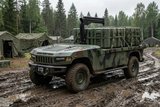
The equipment includes T-72B3 modernised tanks; the BM-21 Grad multiple launch rocket system; Akatsiya self-propelled artillery systems; UAS; Borisoglebsk-2 electronic jamming systems; Ural trucks, and other hardware.
The T-72B3 tanks are equipped with new communication equipment, fire control system and thermal sighting system.
Related Equipment in Defence Insight


More from Land Warfare
-
![Can NATO’s CUAS marketplace turn urgent demand into deliveries?]()
Can NATO’s CUAS marketplace turn urgent demand into deliveries?
Framework contracts and leasing options aim to shorten acquisition timelines, while manufacturing partnerships could help suppliers scale production to meet allied demand.
-
![A medium UGV market emerges as the US weighs up its options]()
A medium UGV market emerges as the US weighs up its options
The US is pursuing multiple UGV programmes, from commercial robotic platforms to new autonomy technologies. The combination of these efforts could prove key to turning ambition into operational capability.
-
![NATO looks for answers to overcome standards hurdles and improve procurement]()
NATO looks for answers to overcome standards hurdles and improve procurement
NATO is looking to artificial intelligence to provide integration between different C2 systems to create a common operational picture, potentially offering a faster route to interoperability than the slow-moving processes of NATO standards committees.
-
![NATO FUSE exercise plays out real-world scenario in the face of eastern border risks]()
NATO FUSE exercise plays out real-world scenario in the face of eastern border risks
The large-scale exercise in Latvia was the culmination of three experimentation initiatives to see how platforms, weapons and systems could fit into the alliance’s Eastern Flank Deterrence Initiative. As well as forces, it brought together companies and equipment.
-
![Canada accelerates uncrewed aerial system procurement for NATO and Arctic forces]()
Canada accelerates uncrewed aerial system procurement for NATO and Arctic forces
Canada plans to acquire at least 120 uncrewed aerial systems through two competitions with combined funding ceilings of C$32 million.