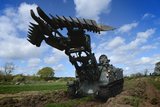
Leonardo launches new turrets for land and naval platforms
Leonardo's new Hitfist 30 UL (left) and Lionfish 30 (right). (Photo: Giovanni Rasio)
At SeaFuture 2023 in La Spezia, Italy, Leonardo launched two new turrets for land and naval applications.


The turrets, the Lionfish 30 and Hitfist 30 UL are both remote-controlled and integrate the new 30mm X-Gun.
This electrically powered, ITAR-free weapon was developed in-house by Leonardo.
The Hitfist 30 UL remote-controlled turret is lighter and more compact than other Hitfist variants and can be installed on vehicles with restrictive weight requirements.
Using air-burst ammunition, the Hitfist 30 UL is described as effective against all kinds of asymmetric threats.
The Hitfist 30 UL can also integrate an optional secondary coaxial machine gun.
The turret’s aiming system is fully stabilised and offers a firing elevation of between -10 degrees and
Our news & analysis is now part of Defence Insight®
A Basic-level or higher Defence Insight subscription is now required to view this content.



More from Land Warfare
-
![Tulpar firing trials expand Hitfact Mk II platform options]()
Tulpar firing trials expand Hitfact Mk II platform options
Firing trials of the Tulpar and Leonardo Hitfact Mk II combination follow an integration programme covering mechanical, electrical, electronic and software interfaces.
-
![How to breach a minefield: from traditional systems to modern techniques in action]()
How to breach a minefield: from traditional systems to modern techniques in action
The news from Ukraine has again shown that antitank minefields and other obstacles on the battlefield, such as deep trenches, can play a key role in both offensive and defensive operations. Given this, there will always be a need to clear them, both during and after a conflict.
-
![British Army's open plan draws diverse offerings for Land Rover replacement]()
British Army's open plan draws diverse offerings for Land Rover replacement
The UK Ministry of Defence has avoided being prescriptive in its search to replace the British Army’s Land Rover, meaning vehicle types being offered range from Land Rover Defender Wolf II and Humvee to the hybrid series Fering Pioneer. What does this mean for the procurement process?
-
![DVD 2026: British Army’s Ajax back in the hands of users as part of a gradual return]()
DVD 2026: British Army’s Ajax back in the hands of users as part of a gradual return
The introduction of Ajax vehicles into British Army service was stopped after operator health issues were reported during an exercise, but manufacturer General Dynamics Land Systems UK believes work over the past 10 months has dealt with the problems.