Iran and the future of amphibious operations: crewed and uncrewed solutions
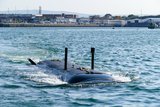
Squire is an autonomous uncrewed surface and aerial vehicle being developed by REGENT. (Photo: REGENT)
Amphibious operations are a very unique type of military operation, and global defence industries are developing new solutions to enhance capabilities and efficiency.


Thousands of US Marines from the 11th and 31st Expeditionary Units are currently en route to the Middle East aboard US warships, in addition to the 82nd Airborne Division. It is believed there is a strong possibility that the US government could carry out a ground operation in Iran, including Kharg Island, to reopen the Strait of Hormuz.
This hypothetical operation would include an amphibious component. While landing craft will continue to be used for beach landings, there are emerging technologies, both crewed and uncrewed, to support troops.
In January, Adm Daryl Caudle, the US Navy’s (USN) chief
Our news & analysis is now part of Defence Insight®
A Basic-level or higher Defence Insight subscription is now required to view this content.
More from Naval Warfare
-
![How France’s SNLE 3G programme is reshaping the naval nuclear industrial base]()
How France’s SNLE 3G programme is reshaping the naval nuclear industrial base
Extending far beyond a four-submarine replacement programme, France’s ballistic missile submarine effort is a decades-long industrial initiative designed to preserve the country’s ability to build and sustain nuclear-powered strategic platforms.
-
![Quantum Systems enters maritime domain with Baltic-focused USV and UUV]()
Quantum Systems enters maritime domain with Baltic-focused USV and UUV
Quantum Systems has launched into the maritime domain with Seavex and Subvex, aiming to close a Baltic Sea ISR gap opened by infrastructure sabotage.
-
![China’s mineral processing dominance exposes naval supply chain vulnerabilities]()
China’s mineral processing dominance exposes naval supply chain vulnerabilities
Competition for critical minerals, and China’s dominance of their processing, is emerging as a decisive factor in future naval procurement programmes.
-
![Suppliers await next step in Australia’s mine warfare transition]()
Suppliers await next step in Australia’s mine warfare transition
Australia’s mine countermeasure capability remains in flux as the Huon-class nears retirement, but accelerated investment in autonomous systems is opening a path for industry.