Germany buys additional BvS10 all-terrain vehicles
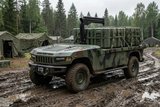
A rendering of variants of the BvS10. (Image: BAE Systems)
Germany is procuring an additional 227 ultra-mobile, all-terrain BvS10 vehicles from BAE Systems through a framework agreement.


The German contract, worth around $400 million, follows a joint procurement of the vehicle by Sweden, Germany and the UK to support Arctic operations under the Stockholm-led Collaborative All-Terrain Vehicle (CATV) programme.
BAE Systems Hägglunds MD Tommy Gustafsson-Rask said: ‘This framework agreement streamlines the process by allowing prospective and existing customers to acquire vehicles at previously negotiated terms, while also benefiting from the joint development.
‘This will secure Germany’s access to these highly capable vehicles for decades to come, and demonstrates the strong relationship between BAE Systems and our customer.’
Related Articles
Germany moves to upgrade Puma armoured vehicles as additional procurement remains on hold
Austria, France and the Netherlands also operate the vehicle. Its unarmoured variant, Beowulf, won the US Army’s Cold Weather All-Terrain Vehicle (CATV) programme last August, under which 110 vehicles will be provided over five years.
The new contract with Berlin covers additional troop transport vehicles, armoured personnel carriers (APCs), and three new German BvS10 variants for command and control (C2) and logistics.
The articulated vehicles offer high mobility in all conditions, including snow, ice, sand, swamps, and mountainous terrain.
The BvS10’s amphibious features allow it to ‘swim’ in flooded areas and off coastlines.
Related Programmes in Defence Insight
Related Equipment in Defence Insight

You may also like

More from Land Warfare
-
![Clearer military requirements could unlock UGV market growth]()
Clearer military requirements could unlock UGV market growth
Western armies continue to test uncrewed ground vehicles, but wider procurement will depend on turning ambitions for autonomy into defined operational roles and funded requirements.
-
![Can NATO’s CUAS marketplace turn urgent demand into deliveries?]()
Can NATO’s CUAS marketplace turn urgent demand into deliveries?
Framework contracts and leasing options aim to shorten acquisition timelines, while manufacturing partnerships could help suppliers scale production to meet allied demand.
-
![A medium UGV market emerges as the US weighs up its options]()
A medium UGV market emerges as the US weighs up its options
The US is pursuing multiple UGV programmes, from commercial robotic platforms to new autonomy technologies. The combination of these efforts could prove key to turning ambition into operational capability.
-
![NATO looks for answers to overcome standards hurdles and improve procurement]()
NATO looks for answers to overcome standards hurdles and improve procurement
NATO is looking to artificial intelligence to provide integration between different C2 systems to create a common operational picture, potentially offering a faster route to interoperability than the slow-moving processes of NATO standards committees.
-
![NATO FUSE exercise plays out real-world scenario in the face of eastern border risks]()
NATO FUSE exercise plays out real-world scenario in the face of eastern border risks
The large-scale exercise in Latvia was the culmination of three experimentation initiatives to see how platforms, weapons and systems could fit into the alliance’s Eastern Flank Deterrence Initiative. As well as forces, it brought together companies and equipment.
-
![Canada accelerates uncrewed aerial system procurement for NATO and Arctic forces]()
Canada accelerates uncrewed aerial system procurement for NATO and Arctic forces
Canada plans to acquire at least 120 uncrewed aerial systems through two competitions with combined funding ceilings of C$32 million.