Frazer-Nash provides architecture for next-gen UGVs
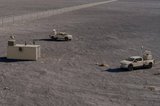
Dstl purchased HORIBA MIRA's Viking to aid in the development of a future ground combat vehicle. (Photo: HORIBA MIRA)
Frazer-Nash is working with Dstl’s Future Ground Combat Vehicle team to develop and test generic architectures for the next generation of UGVs.


The Frazer-Nash is supporting Dstl’s Future Ground Combat Vehicle team to develop a generic architecture for future UGVs that is modular and open.
This architecture will allow UGVs to be rapidly configured with mission-specific fits and supports through life insertion of new and improved technologies as they mature.
It will provide UGV and UGV sub-system suppliers with a framework for product development and exploitation.
Frazer-Nash has produced a prototype architecture along with recommendations for adopting applicable standards and successfully demonstrated it at the Armoured Trials and Development Unit in Dorset.
As part of the demonstration, the re-rolling of UGVs with multiple mission modules in a battlefield scenario was showcased. It proved that the architecture could enable quick configuration of different mission modules in a battlefield scenario.
It also demonstrated that two different UGVs could be controlled from the same base station, as part of a single communication domain, which will allow the land forces to use more UGVs in missions without increasing manning requirements.
The final element of the demonstration showcased the handover of control from one base station to another on the same network, this will allow operators to transfer control between mounted and dismounted units.



More from Land Warfare
-
![Front-line support: how UK industry is helping tackle Ukraine’s landmine challenges]()
Front-line support: how UK industry is helping tackle Ukraine’s landmine challenges
Pearson Engineering has provided equipment and engineering expertise to the Armed Forces of Ukraine since the beginning of the full-scale Russian invasion in 2022. The British company is now working to deepen engagement with the Ukrainian defence industry, expanding its support for the country’s population and laying the foundations for future technological innovation.
-
![AUSA 2026: companies adapt munitions and missiles for greater effect at lower costs]()
AUSA 2026: companies adapt munitions and missiles for greater effect at lower costs
Rather than developing entirely new weapons, defence companies are looking to build on existing weapons and systems to deliver greater capability, control costs and accelerate fielding.
-
![With changing patterns in Middle Eastern procurement, is Europe missing out?]()
With changing patterns in Middle Eastern procurement, is Europe missing out?
Traditional suppliers are struggling to meet the Middle East’s armoured vehicle modernisation needs, creating opportunities for South Korean manufacturers and regional defence industries.
-
![AUSA 2026: CUAS market expands as suppliers target new threats and operational requirements]()
AUSA 2026: CUAS market expands as suppliers target new threats and operational requirements
New developments from MARSS, MyDefence, Mountain Horse Solutions and Rafael suggest that future counter-drone protection will increasingly depend on combining advanced detection, rapid interception and integrated defensive networks.